
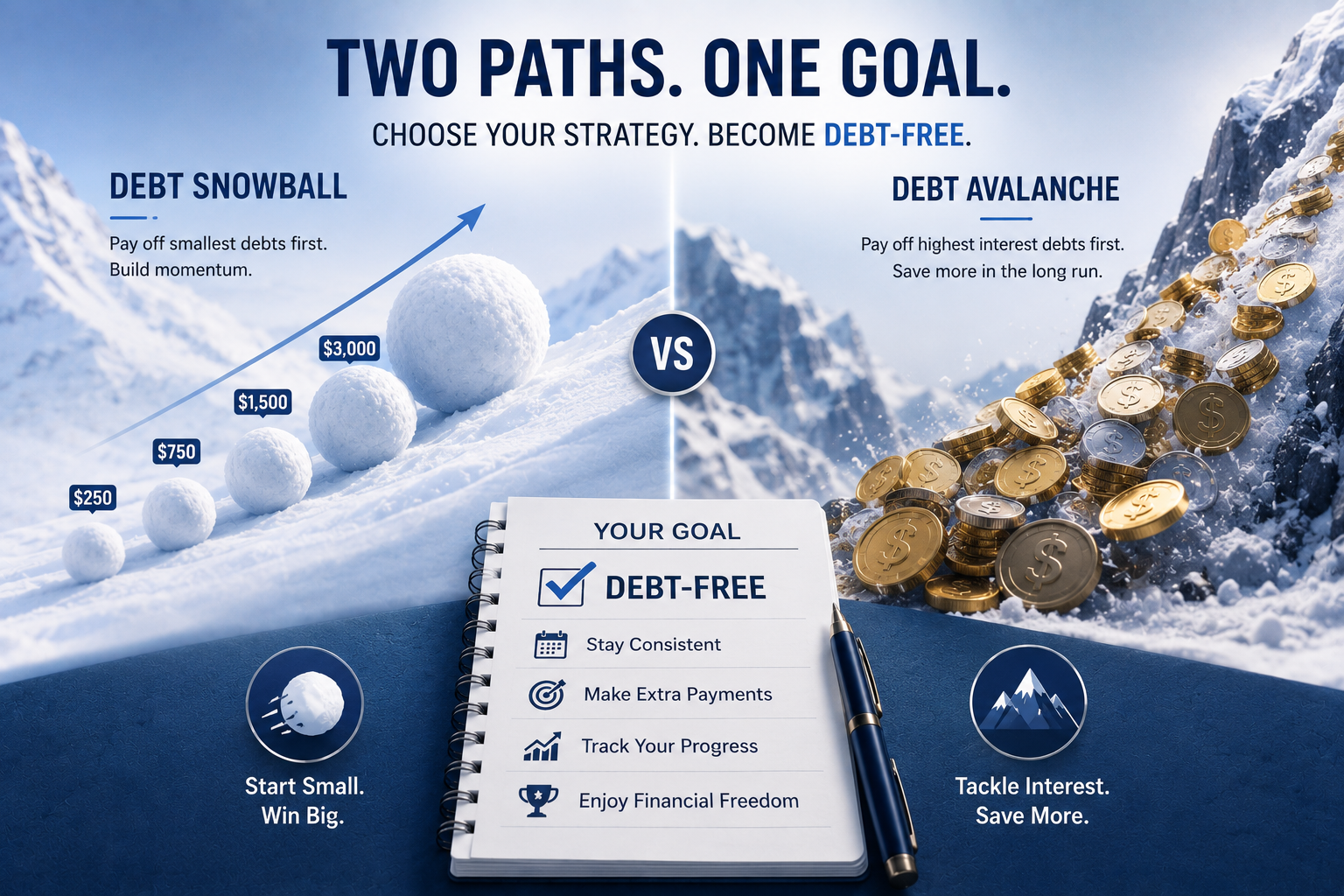
If you’ve ever sat down with a stack of bills, a spreadsheet, and a growing sense of dread, you’ve probably searched for a way out that actually feels doable. Two strategies keep coming up in almost every debt payoff conversation: the debt snowball and the debt avalanche. Both work. Both have loyal fans. And both can leave you feeling more confused than when you started, especially when finance influencers argue about which one is “objectively better.”
Here’s the truth that rarely gets said clearly enough: there is no universally correct answer. The best debt payoff strategy is the one you’ll actually stick with until your debt is gone. Math matters, but so does motivation, and for most people, motivation is the harder problem to solve.
This guide breaks down exactly how each method works, the real numbers behind them, and how to figure out which one actually fits your personality, your debt situation, and your life right now.
Understanding The Debt Payoff Problem
Before comparing strategies, it helps to understand why a strategy matters at all. If you have multiple debts, whether credit cards, personal loans, student loans, or a mix of everything, you generally have two choices for extra payments beyond the minimums: decide which debt gets your extra money each month, or spread it evenly and hope for the best.
Spreading it evenly rarely works well. It stretches out every balance at roughly the same slow pace, and you lose the psychological and financial benefits of fully eliminating any single debt. That’s where structured strategies like the snowball and avalanche methods come in. Both funnel every extra dollar toward one target debt at a time while maintaining minimum payments on everything else, then roll that payment amount onto the next debt once the first is paid off.
The difference lies entirely in how you choose which debt to attack first.
What Is The Debt Snowball Method?
The debt snowball method, popularized widely by financial personalities like Dave Ramsey, orders your debts from smallest balance to largest, regardless of interest rate.
Here’s how it works step by step:
- List all your debts from smallest balance to largest.
- Continue making minimum payments on every debt.
- Put any extra available money toward the smallest debt until it’s completely paid off.
- Once that debt is gone, roll its entire payment amount, minimum plus whatever extra you were paying, into the next smallest debt.
- Repeat this process, with your payment “snowballing” larger and larger as each debt disappears, until you’re debt-free.
Why People Love The Snowball Method
The core appeal of the snowball method is psychological momentum. Paying off an entire debt, even a small one, produces a genuine sense of accomplishment that’s hard to replicate with a partial payment spread across several balances.
For many people struggling with debt, the emotional weight of the situation is just as real as the financial one. Seeing an account hit zero, even if it’s not the highest-interest debt, provides visible proof that the plan is working. That motivation often makes the difference between someone sticking with a payoff plan for years or giving up after a few discouraging months.
What Is The Debt Avalanche Method?
The debt avalanche method takes a purely mathematical approach. Instead of ordering debts by balance size, you order them by interest rate, from highest to lowest.
Here’s how it works:
- List all your debts from highest interest rate to lowest, regardless of balance size.
- Continue making minimum payments on every debt.
- Put any extra available money toward the debt with the highest interest rate until it’s paid off.
- Roll that payment into the debt with the next highest interest rate.
- Continue this process until all debts are paid off.
Why People Love The Avalanche Method
The debt avalanche method minimizes the total interest you pay over the life of your debt payoff journey. Since high-interest debt, like many credit cards, accumulates cost far faster than lower-interest debt, tackling it first generally means less money lost to interest charges overall and, in many cases, a slightly faster full payoff timeline.
For people who are motivated primarily by numbers and efficiency, rather than emotional milestones, the avalanche method often feels like the more logical, satisfying choice.
Debt Snowball vs Debt Avalanche: A Side-By-Side Comparison
Let’s look at a simplified example to see how these methods actually play out differently in practice.
Imagine you have three debts:
- Credit Card A: $1,000 balance, 24% interest rate
- Personal Loan: $4,000 balance, 12% interest rate
- Credit Card B: $2,500 balance, 19% interest rate
With the debt snowball, you’d tackle them in this order: Credit Card A ($1,000) first, then Credit Card B ($2,500), then the Personal Loan ($4,000) last, regardless of interest rate.
With the debt avalanche, you’d tackle them in this order: Credit Card A (24%) first, then Credit Card B (19%), then the Personal Loan (12%) last, based purely on interest rate.
Interestingly, in this particular example, both methods actually result in the exact same payoff order, since the smallest balance happens to carry the highest interest rate. This isn’t always the case, though. If Credit Card A had a lower interest rate than the Personal Loan despite having a smaller balance, the two strategies would diverge, with the avalanche method prioritizing the loan’s higher rate first despite its larger size, while the snowball method would still start with the smaller Credit Card A balance.
In situations where balances and interest rates don’t line up neatly, the avalanche method will almost always save you more in total interest, sometimes significantly, especially if your highest-interest debt also happens to have a large balance. The snowball method, in those same situations, may take slightly longer and cost a bit more in total interest, but it front-loads quick wins that keep many people motivated enough to actually finish the plan.
The Real Numbers: How Much Difference Does It Actually Make?
For people with a few thousand dollars in fairly similar debts, the difference between the two methods is often surprisingly small, sometimes just a matter of a few months and a relatively modest amount of extra interest paid.
For people with larger, more varied debt loads, particularly where high-interest debt also carries a large balance, the avalanche method can save considerably more in total interest and shave meaningful time off the overall payoff timeline.
The key takeaway: the avalanche method is mathematically optimal or equal in virtually every scenario, but the actual dollar difference varies widely depending on your specific mix of balances and interest rates. For some people, it’s a small optimization. For others, it’s a genuinely significant amount of money.
Which Strategy Fits You Best?
Rather than asking which method is “better” in the abstract, it’s more useful to ask which one fits your specific situation, personality, and debt profile. Here’s how to think through it.
Choose The Debt Snowball If:
You’ve struggled to stick with debt payoff plans in the past. If previous attempts at budgeting or debt payoff have fizzled out after a few months, the quick wins of the snowball method can provide the motivation needed to actually follow through this time.
You feel emotionally overwhelmed by your debt. Debt often carries significant stress and shame, and quick, visible progress can meaningfully reduce that emotional burden, making the entire process feel more manageable.
Your interest rates are relatively similar across debts. If the difference in interest rates between your debts isn’t dramatic, the mathematical advantage of the avalanche method shrinks, making the motivational benefits of the snowball method a more compelling deciding factor.
You need visible proof that the plan is working to stay consistent. Some people are simply wired to respond better to milestone-based progress than abstract, long-term optimization.
Choose The Debt Avalanche If:
You’re motivated primarily by logic, numbers, and efficiency. If watching your total interest paid decrease feels more satisfying to you than closing individual accounts, the avalanche method will likely keep you more engaged.
You have significant interest rate differences between your debts. The bigger the gap between your highest and lowest interest rates, the more money the avalanche method will save you, making the mathematical case increasingly compelling.
You’re disciplined enough to stay consistent without frequent small wins. If you’ve successfully stuck with long-term financial or personal goals before without needing constant positive reinforcement, the avalanche method’s slower initial visible progress won’t be as much of a risk factor for you.
Minimizing total cost matters more to you than accelerating early motivation. For some people, knowing they’re making the most financially efficient choice is itself motivating, regardless of how quickly individual accounts get closed.
A Hybrid Approach: Can You Combine Both Methods?
Yes, and many people do, whether intentionally or through practical necessity. A few common hybrid approaches include:
Starting with a small, quick win, then switching to avalanche. If you have one very small debt that can be paid off within a month or two, some people knock that out first for an early motivational boost, then switch to strict avalanche ordering for the remaining debts.
Weighing both balance and interest rate together. Rather than following either method rigidly, you might prioritize a debt that’s both relatively small and carries a meaningfully high interest rate, capturing some benefits of both approaches.
Adjusting your strategy if your motivation shifts over time. It’s completely reasonable to start with the snowball method for early momentum, then shift to avalanche once you’ve built confidence and consistency in your payoff routine.
There’s no rule that says you must rigidly follow one method from start to finish. The most important factor remains whether your chosen approach keeps you consistently making extra payments toward becoming debt-free.
Practical Tips For Success With Either Method
Automate your minimum payments. Regardless of which strategy you choose, automating minimum payments across all your debts protects your credit score from missed payment penalties while you focus extra funds on your target debt.
Track your progress visually. A simple chart, spreadsheet, or app showing your total debt decreasing over time can reinforce motivation for either method, not just the snowball approach.
Look for ways to increase your extra payment amount. Whether through a temporary side income, selling unused items, or trimming discretionary spending, even modest increases to your extra monthly payment can meaningfully accelerate either payoff strategy.
Consider balance transfers or refinancing where appropriate. In some cases, transferring high-interest credit card debt to a lower-interest option, or refinancing a loan, can effectively combine with either payoff strategy to reduce your overall interest burden further. Be mindful of transfer fees and promotional period terms before committing.
Build a small emergency buffer alongside your debt payoff plan. Without any cushion, an unexpected expense can force you back onto high-interest debt, undoing progress from either method. Even a modest emergency fund provides valuable protection during your payoff journey.
Revisit your budget regularly. As your income or expenses change, adjusting how much extra you’re able to put toward debt keeps your chosen strategy realistic and sustainable over time.
Common Mistakes People Make With Debt Payoff Strategies
Switching methods too frequently. Constantly jumping between strategies based on short-term frustration can slow overall progress and create confusion about which debt to prioritize next.
Ignoring minimum payments on other debts. Focusing so heavily on one target debt that minimum payments on other balances get missed can damage your credit score and add unnecessary late fees, undermining the entire plan.
Choosing a method based purely on what worked for someone else. What keeps one person motivated might not work for you at all. Your own tendencies, especially around motivation and consistency, matter more than someone else’s success story.
Underestimating the value of small emotional wins. Even avalanche method purists sometimes underestimate how much frustration and eventual burnout can be avoided by acknowledging progress along the way, not just tracking the numbers.
Failing to address the root cause of the debt. Neither strategy addresses spending habits or financial circumstances that may have led to the debt in the first place. Pairing your payoff plan with a realistic budget helps prevent falling back into the same situation once your debt is cleared.
Final Thoughts
The debt snowball and debt avalanche methods both lead to the same destination: a debt-free future. The real question isn’t which method is objectively superior, but which one you can realistically stick with until you get there. If quick, visible wins keep you motivated and consistent, the snowball method’s psychological momentum may serve you better, even if it costs a bit more in total interest. If you’re driven by efficiency and want to minimize the total cost of your debt, the avalanche method offers a more mathematically optimal path.
Whichever method you choose, the most important factor is consistency. A slightly less “optimal” strategy that you actually follow through on will always outperform a perfect strategy abandoned after a few discouraging months. Pick the approach that fits how you’re wired, commit to it, and let steady progress do the rest.
Frequently Asked Questions
Which method saves more money overall? The debt avalanche method typically saves more in total interest since it prioritizes your highest-interest debt first, though the actual dollar difference depends on how varied your interest rates and balances are.
Which method is faster? The avalanche method is usually slightly faster or equal in total payoff time, since it minimizes the interest accumulating across your remaining debts. The difference in speed is often modest unless your interest rates vary significantly.
Can I switch between methods partway through my debt payoff journey? Yes. Many people start with one method and switch to the other as their circumstances or motivation change. Consistency in making extra payments matters more than rigidly following one method from start to finish.
Do these methods work for all types of debt? Both methods can be applied to most common debt types, including credit cards, personal loans, and some student loans. However, mortgages and certain other secured loans are often excluded from these strategies and treated separately in a broader financial plan.
What if I can’t afford extra payments toward any debt right now? Focus first on covering all minimum payments and building a small financial cushion. Once your budget allows for even a modest extra payment amount, you can begin applying either the snowball or avalanche method to accelerate your progress.