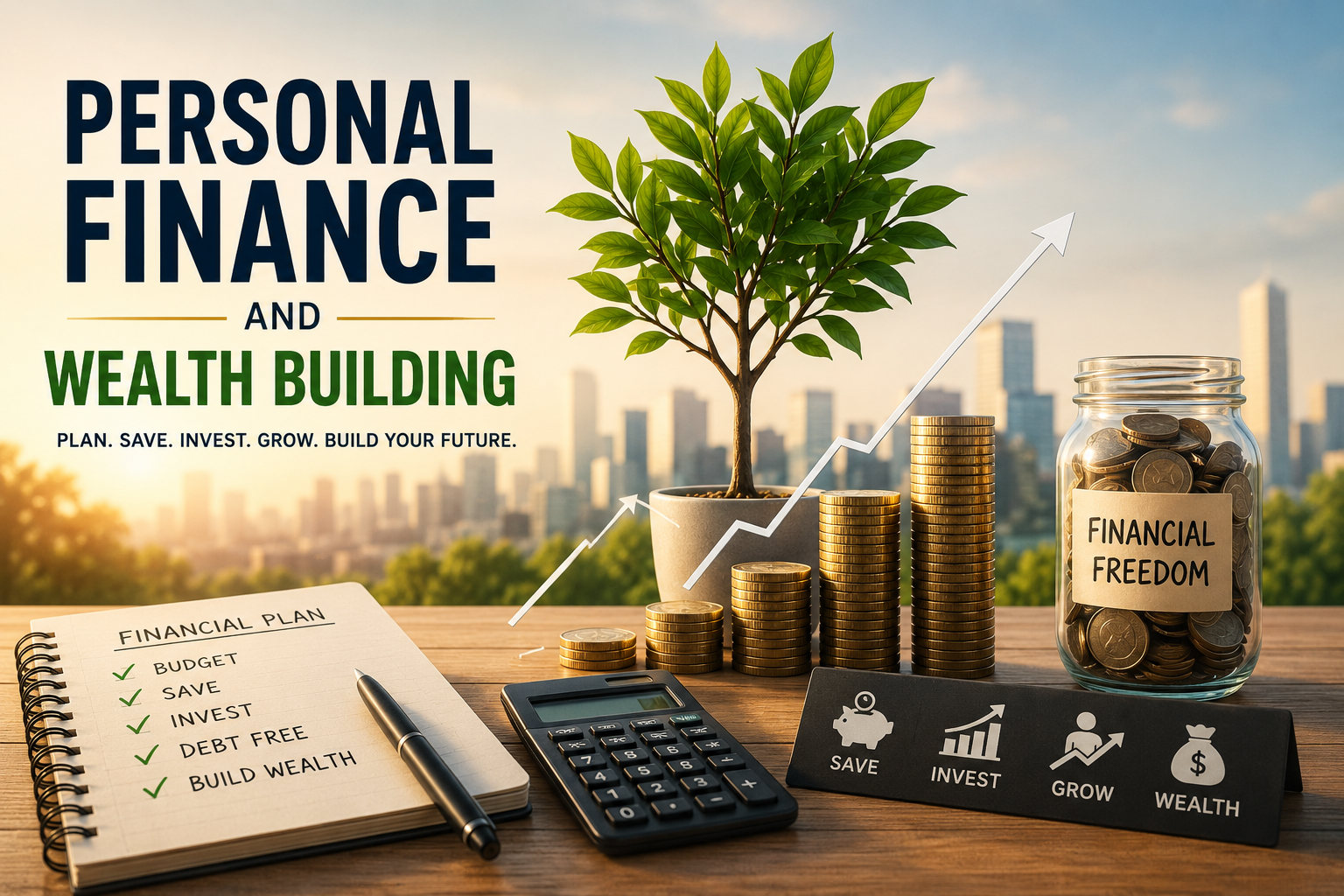
The Architecture of Wealth: A Strategic Guide to Investing and Building Lasting Financial Freedom
By [Your Name] | Finance & Wealth Strategy
Wealth is not a matter of luck. It is not the exclusive domain of the ultra-educated, the well-connected, or those born into privilege. Wealth, at its core, is the product of a disciplined system — one built on principles that have withstood economic cycles, market crashes, geopolitical upheaval, and generational shifts. The investors who consistently build and preserve wealth are not necessarily the most brilliant people in the room. They are the most patient, the most systematic, and the most committed to principles over emotion.
This article is a comprehensive guide to understanding how investing works, why most people fail at it, and what separates those who successfully build wealth from those who perpetually chase it.
The Fundamental Shift: From Earner to Owner
The single most important mindset transformation in wealth building is the shift from being an earner to being an owner.
Earners trade time for money. They work, they get paid, and when they stop working, the income stops. This is the default setting for most people — and it is perfectly respectable. But it is not a path to financial independence.
Owners, by contrast, deploy capital to generate income. They buy assets — stocks, real estate, businesses, bonds — and those assets produce returns whether the owner is working, sleeping, or traveling. The income compounds. The assets appreciate. Over time, the gap between earners and owners widens dramatically.
This is not a moral judgment about employment. Most wealth builders earn a salary — especially in the early stages. The key insight is that income from employment must be systematically converted into income-generating assets. Every dollar you save and invest is a small worker you deploy on your behalf, one that works 24 hours a day, 365 days a year, without complaint.
The earlier you make this mental shift, the more powerful its effects.
Understanding Compound Growth: The Eighth Wonder of the World
Albert Einstein reportedly called compound interest “the eighth wonder of the world,” though historians debate the attribution. Regardless of who said it, the concept is profoundly true — and widely underestimated.
Compounding is the process by which returns generate their own returns. When you invest $10,000 at an annual return of 8%, you earn $800 in the first year — giving you $10,800. In the second year, you earn 8% on $10,800, not just $10,000. That produces $864. The difference seems small. But project this forward over decades, and the results are staggering.
A $10,000 investment at 8% annually:
- After 10 years: approximately $21,589
- After 20 years: approximately $46,610
- After 30 years: approximately $100,627
- After 40 years: approximately $217,245
The money more than doubles every nine years at 8% — a phenomenon captured by the “Rule of 72” (divide 72 by your expected annual return to estimate how long it takes to double your money).
The critical lesson: time is the most powerful variable in the compounding equation. Starting ten years earlier is worth more than doubling your contributions later. This is why financial advisors universally stress the urgency of beginning — not perfectly, not with large sums, but beginning.
The Core Asset Classes and Their Role in a Portfolio
A sophisticated investor understands that different asset classes serve different purposes. A well-constructed portfolio is not a gamble on a single asset — it is a deliberate allocation across instruments with different risk-return profiles, behaviors in different economic environments, and liquidity characteristics.
Equities (Stocks)
Equities represent ownership in companies. Over long periods, the global stock market has delivered average annual returns of approximately 7–10% (adjusted for inflation in the case of U.S. markets). This makes stocks the primary engine of long-term wealth creation for most investors.
The trade-off is volatility. Stock prices fluctuate — sometimes dramatically. Markets have historically declined 20%, 30%, even 50% during major crises. Investors who panic-sell during downturns lock in losses and miss recoveries. Investors who hold — or buy more — during corrections are rewarded.
There are two primary approaches to equity investing:
Index Investing involves buying funds that track broad market indices (such as the S&P 500 or MSCI World). This approach is passive, low-cost, and supported by decades of evidence suggesting it outperforms the majority of actively managed funds over the long term. Pioneered by John Bogle of Vanguard, index investing has democratized wealth building for ordinary investors.
Active Investing involves selecting individual stocks or actively managed funds in an attempt to outperform the market. This requires significant research, expertise, and emotional discipline. Academic studies consistently show that most active fund managers underperform their benchmarks after fees — though skilled individual investors who develop genuine expertise can generate superior returns.
Fixed Income (Bonds)
Bonds are debt instruments — loans made to governments or corporations in exchange for periodic interest payments and return of principal at maturity. They are generally less volatile than stocks and serve as a stabilizing force in portfolios.
In low-interest-rate environments, bonds offer modest returns. But they provide crucial ballast during equity market downturns, as investors often rotate into bonds during periods of uncertainty, driving their prices up.
The classic 60/40 portfolio (60% equities, 40% bonds) has been the benchmark for balanced investing for decades — though many modern advisors argue for higher equity allocations in the current environment, particularly for younger investors with long time horizons.
Real Estate
Real estate offers several wealth-building advantages: rental income, capital appreciation, tax benefits, and a hedge against inflation. Unlike stocks, real estate is a tangible asset with intrinsic utility — people will always need places to live and work.
Direct real estate investing requires significant capital, active management, and carries illiquidity risk. However, Real Estate Investment Trusts (REITs) allow investors to gain exposure to diversified real estate portfolios through publicly traded securities, combining the benefits of real estate with the liquidity of stocks.
Alternative Investments
Beyond the traditional asset classes, sophisticated investors may explore private equity, hedge funds, commodities, infrastructure, or private credit. These alternatives can enhance diversification and potentially boost returns, but typically require higher minimum investments, carry lower liquidity, and demand greater due diligence.
The Strategic Framework: How to Build Wealth Systematically
Knowing what to invest in is only half the equation. The how — the strategic framework — determines whether knowledge translates into actual wealth creation.
1. Build a Solid Financial Foundation First
Before investing aggressively, establish the fundamentals:
- Emergency Fund: Maintain three to six months of living expenses in a liquid, accessible account. This prevents you from being forced to liquidate investments at inopportune moments when unexpected expenses arise.
- High-Interest Debt Elimination: No investment strategy reliably outperforms the guaranteed “return” of paying off high-interest debt. Credit card debt at 20% annual interest is a guaranteed 20% return when eliminated. Prioritize this before investing beyond employer-matched retirement contributions.
- Adequate Insurance: Wealth destruction often comes not from poor investments but from uninsured catastrophes — medical emergencies, disability, liability. Proper insurance coverage protects the financial architecture you are building.
2. Maximize Tax-Advantaged Accounts
One of the highest-return strategies available to most investors is not a specific stock pick — it is tax optimization. Tax-advantaged accounts (such as 401(k)s, IRAs, Roth IRAs in the U.S., or their equivalents in other jurisdictions) allow investments to compound either tax-deferred or tax-free, dramatically accelerating wealth accumulation.
Always capture employer matching contributions first. This is an immediate 50–100% return on invested capital that no market instrument can reliably replicate.
3. Invest Consistently and Automatically
The discipline of investing consistently — regardless of market conditions — is more predictive of long-term wealth than market timing. A strategy known as dollar-cost averaging involves investing a fixed amount at regular intervals. This approach automatically purchases more shares when prices are low and fewer when prices are high, reducing the impact of volatility over time.
Automate your investments wherever possible. Remove human judgment — and therefore emotion — from the equation. Treat investment contributions like utility bills: non-negotiable and automatic.
4. Diversify Thoughtfully
Diversification is the only “free lunch” in investing — the ability to reduce risk without proportionally reducing expected returns. A properly diversified portfolio spreads exposure across asset classes, geographies, sectors, and instruments.
However, there is an important distinction between intelligent diversification and what Warren Buffett calls “diworsification” — owning so many positions that outperformance becomes impossible. The goal is not to own everything. It is to ensure that no single failure — of a company, sector, or country — can catastrophically damage your portfolio.
5. Manage Costs Relentlessly
Investment fees compound against you just as returns compound for you. A 1% annual fee on a $500,000 portfolio costs $5,000 per year in direct charges — and far more in foregone compounding over decades.
Favor low-cost index funds and ETFs. Scrutinize the expense ratios of every fund you hold. Minimize trading commissions and tax drag from frequent buying and selling. The investor who earns 8% but pays 0.1% in fees will substantially outperform the investor who earns 8% but pays 1.5% in fees, over time.
The Behavioral Edge: Managing the Psychology of Investing
Markets are rational in the long run but irrational in the short run. This creates both danger and opportunity for investors.
Behavioral economists have identified a range of cognitive biases that systematically undermine investor returns:
- Loss aversion: The pain of losing $1,000 is psychologically more powerful than the pleasure of gaining $1,000. This causes investors to sell too early in downturns and hold losing positions too long.
- Recency bias: Investors extrapolate recent trends indefinitely. After a bull market, they assume markets will always rise. After a crash, they assume markets will never recover.
- Overconfidence: Most investors believe they are above average — a statistical impossibility. This leads to excessive trading, under-diversification, and excessive risk-taking.
- Herding: The impulse to follow the crowd — buying what is popular and selling what is unpopular — is precisely the opposite of what long-term investing requires.
The antidote to these biases is not willpower. It is process. A written investment policy statement, pre-defined rebalancing rules, and automatic contributions create guardrails that prevent emotional decisions from derailing long-term plans.
As Warren Buffett has observed: “The stock market is a device for transferring money from the impatient to the patient.”
Building Multiple Streams of Income
True financial independence is rarely built on a single income stream. Sophisticated wealth builders systematically develop and expand multiple sources of income over time:
- Earned income from employment or self-employment provides the initial capital for investment
- Dividend income from stocks provides regular cash flow without requiring the sale of assets
- Rental income from real estate provides consistent returns tied to tangible assets
- Business income from owned enterprises can deliver outsized returns with appropriate risk
- Royalties and licensing from intellectual property provide passive income from creative or intellectual work
Each income stream reduces dependence on any single source and increases resilience against economic disruption. The goal is to systematically add streams over time — not to attempt all of them simultaneously.
The Role of Financial Education as a Continuous Investment
One of the highest-returning investments available is investment in your own financial literacy. An investor who deeply understands valuations, economic cycles, tax optimization, and asset allocation will consistently make better decisions than one who delegates all financial thinking to others.
This does not mean you should avoid professional advisors — a skilled, fiduciary financial advisor can add enormous value. But it does mean you should never abdicate responsibility for understanding your own financial situation. Read widely. Study the greatest investors — Buffett, Munger, Dalio, Lynch, Templeton. Understand economic history. Know what you own and why.
A Note on Risk Tolerance and Time Horizon
No wealth-building strategy is universally applicable. The appropriate approach depends heavily on two variables: your risk tolerance (how much volatility you can endure without making poor decisions) and your time horizon (how long until you need the capital).
A 25-year-old with a 40-year investment horizon can absorb significant volatility in pursuit of higher returns. A 60-year-old approaching retirement has far less capacity to recover from a severe downturn and should prioritize capital preservation.
Your risk tolerance is not simply what you can mathematically afford — it is what you can emotionally sustain. An aggressive portfolio that causes you to sell in panic during a correction is inferior to a more conservative portfolio you hold through downturns. Know yourself as clearly as you know your investments.
Conclusion: Wealth Is Built in the Ordinary Moments
The architecture of lasting wealth is not constructed in dramatic moments — not in a single brilliant trade, a windfall inheritance, or a lucky bet. It is built in the ordinary, unglamorous discipline of consistent saving, systematic investing, patient compounding, and continuous learning.
The principles are not complex. But they require something rarer than intelligence: sustained commitment over time.
Begin with whatever capital is available to you. Invest consistently. Diversify thoughtfully. Keep costs low. Manage your emotions. And give compounding the time it needs to work its quiet, extraordinary magic.
The investors who build genuine, lasting wealth are not the loudest voices in the room. They are the ones still in the market, still buying, still learning — long after the speculators have come and gone.
This article is intended for educational purposes only and does not constitute personalized financial advice. Consult a qualified financial advisor for guidance tailored to your specific circumstances.