
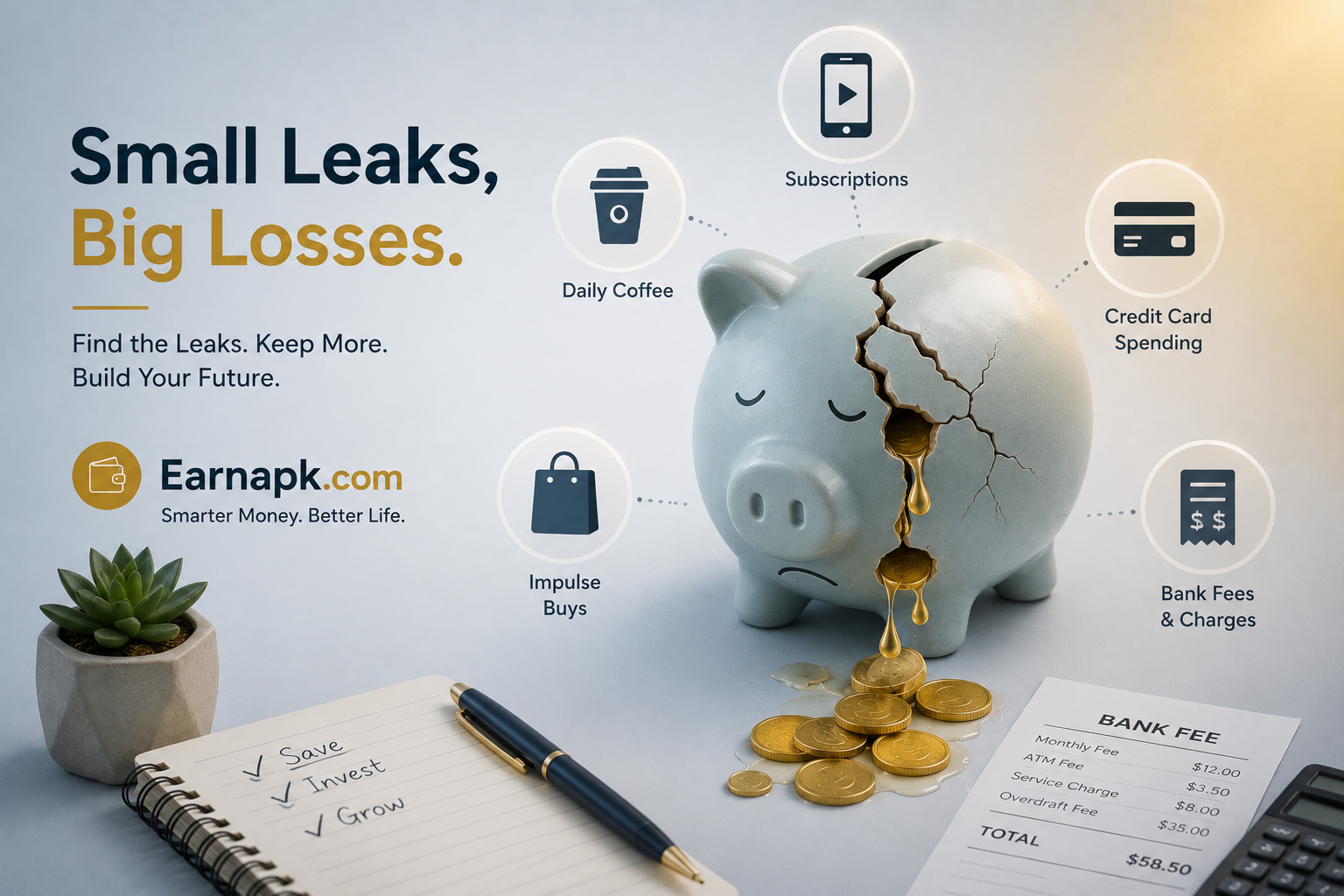
You check your bank account and the number is smaller than it should be. Again. You didn’t make any big purchases, there was no shopping spree, no emergency repair, nothing dramatic. And yet somehow, the math never quite adds up the way it should.
This is one of the most frustrating parts of personal finance. It’s rarely one big mistake that wrecks a budget. It’s a handful of small, easy-to-ignore leaks that quietly siphon money away every single month, so gradually that you barely notice until you actually sit down and add it all up.
The good news is that once you know where to look, these leaks are surprisingly easy to plug. You don’t need to overhaul your entire life or give up everything you enjoy. Most of the time, a little awareness and a few small changes are enough to reclaim a meaningful chunk of money each month. Let’s walk through the ten most common culprits.
1. Subscription Creep
This is the classic one, and for good reason. Streaming services, apps, cloud storage, meal kits, fitness apps, software tools you signed up for during a free trial and forgot to cancel. Individually, each one feels small. A few dollars here, ten dollars there. But stack five or six of these together, and you’re often looking at $50 to $150 a month disappearing on things you barely use, or in some cases, completely forgot you were even paying for.
The tricky part is that subscriptions are designed to be easy to start and annoyingly inconvenient to cancel. Companies know that friction keeps you paying long after the value has faded.
How to plug it: Go through your last two or three bank and credit card statements line by line. For every recurring charge, ask yourself honestly whether you used it in the last month. If the answer is no, cancel it. Set a recurring reminder every few months to repeat this audit, since subscription creep tends to sneak back in over time.
2. Bank And Account Fees
Monthly maintenance fees, overdraft charges, ATM fees from using out-of-network machines, minimum balance penalties. These fees often feel unavoidable, like a normal cost of having a bank account, but in most cases, they’re entirely avoidable with the right account setup.
A single overdraft fee can easily cost $30 or more, and if it happens even occasionally, that adds up fast over a year. Out-of-network ATM fees, which often include a charge from both your bank and the ATM owner, can quietly cost $5 to $10 per withdrawal.
How to plug it: Look into no-fee checking and savings accounts, many of which are now widely available through online banks. Set up low-balance alerts so you’re never caught off guard by an overdraft, and plan ahead to use in-network ATMs whenever possible.
3. Impulse Online Purchases
The convenience of one-click checkout and saved payment information has made impulse buying easier than it has ever been. A late-night scroll turns into a cart full of items you didn’t plan to buy, and because the amounts often feel small individually, it’s easy to underestimate how much this actually adds up to over a month.
Research consistently shows that people spend more when a purchase feels frictionless, and online shopping has been specifically designed to minimize that friction at every step.
How to plug it: Add a deliberate pause before non-essential purchases, even something as simple as a 24-hour rule where you add the item to your cart but wait a day before actually buying it. Removing saved payment information so you have to manually enter your card details each time also adds just enough friction to interrupt impulse spending.
4. Unused Gym Memberships And Underused Services
Gym memberships are one of the most commonly cited examples of money leaks, and for good reason. Many people sign up with genuine motivation, use it heavily for the first few weeks, and then gradually stop going while the monthly charge continues quietly in the background.
This pattern isn’t limited to gyms. It applies to any recurring service you pay for based on intention rather than actual, consistent use: a meal delivery box you rarely cook from, a class subscription you attended twice, a storage unit holding items you haven’t touched in years.
How to plug it: Be honest about your actual usage over the last two or three months, not your intended usage. If a service consistently goes unused, either cancel it or switch to a pay-as-you-go alternative that better matches how you actually engage with it.
5. High-Interest Debt Sitting Untouched
Carrying a balance on high-interest credit cards is one of the most expensive money leaks there is, and it’s often the one people feel least in control of. Minimum payments are structured so that a large portion goes toward interest rather than the actual balance, meaning debt can linger for years while quietly costing hundreds or even thousands of dollars in interest charges.
Because this leak doesn’t show up as a single line item on a statement, it’s easy to underestimate just how much money is being lost to interest rather than going toward things that actually matter to you.
How to plug it: Prioritize paying down high-interest debt as aggressively as your budget allows, and consider whether a balance transfer or debt consolidation option could meaningfully lower your interest rate in the meantime. Even redirecting a modest amount of extra money toward this each month can significantly reduce the total interest paid over time.
6. Auto-Renewing Insurance And Service Plans Without Shopping Around
Many insurance policies, from auto to home to phone protection plans, automatically renew each year, often at a higher rate than the previous term. Because the renewal happens quietly in the background, most people never actually compare their rate against current market options, meaning they continue overpaying simply out of inertia.
Insurance companies frequently rely on this exact behavior, offering more competitive rates to new customers than to loyal, long-standing ones who never bother to shop around.
How to plug it: Set a calendar reminder a few weeks before each major policy renews, and take fifteen minutes to compare rates from a couple of other providers. Even if you ultimately stay with your current provider, this comparison alone can sometimes prompt them to offer you a better rate to retain your business.
7. Convenience Spending On Food And Drinks
Grabbing coffee on the way to work, ordering delivery instead of cooking, picking up lunch because you didn’t have time to prep something at home. None of these individual choices are inherently bad, but when they become a daily default rather than an occasional treat, the cumulative cost is often far higher than people realize.
A daily coffee purchase alone can easily add up to $80 to $150 a month, and food delivery, once you factor in service fees, delivery fees, and tips, frequently costs two to three times what the same meal would cost if prepared at home.
How to plug it: This doesn’t require eliminating convenience spending entirely, just becoming intentional about it. Try tracking exactly how much you spend on convenience food and drinks for a single month, then decide how much of that feels worth it to you and where you’d rather cut back.
8. Paying Full Price Out Of Habit
Many people default to paying full price simply because comparing prices, searching for discount codes, or timing a purchase around a sale feels like extra effort they don’t want to bother with. Over the course of a year, this habit alone can mean paying noticeably more than necessary for the exact same items and services.
This applies to everything from everyday shopping to larger purchases like electronics, furniture, and travel bookings, where prices often fluctuate significantly based on timing.
How to plug it: Build a simple habit of a quick price comparison or discount code search before finalizing non-urgent purchases. Browser extensions that automatically search for applicable discount codes at checkout can handle much of this effort for you with minimal ongoing thought.
9. Lifestyle Inflation After A Raise Or Bonus
This leak is sneaky because it doesn’t feel like a leak at all. It feels like reasonable, well-earned upgrades. A raise comes through, and almost immediately, spending quietly rises to match it: a nicer apartment, more frequent dining out, upgraded everyday purchases. Before long, the extra income has been fully absorbed into a slightly more expensive lifestyle, with little to no additional money actually being saved or invested.
Lifestyle inflation is one of the most common reasons people earn significantly more over time without their actual savings or net worth growing at a similar pace.
How to plug it: When you receive a raise or bonus, consider deciding in advance what percentage will go toward savings or investing before the rest becomes available for lifestyle spending. Automating that allocation the moment the extra income arrives makes it far less likely to simply disappear into daily spending creep.
10. Ignoring Small Recurring Price Increases
Streaming services, software subscriptions, gym memberships, and insurance premiums often increase gradually over time, sometimes just a dollar or two at a time. Because each individual increase feels negligible, most people don’t notice or bother to react to any single change. But compounded across multiple services over several years, these small increases can add up to a meaningfully higher monthly baseline than you originally signed up for.
How to plug it: During your periodic subscription and bill audit, compare current prices against what you remember paying when you first signed up. If a service has crept up significantly without a corresponding increase in value, it’s worth reconsidering whether it’s still worth keeping, negotiating a better rate, or switching to a more competitively priced alternative.
How To Actually Find Your Own Money Leaks
Reading about common money leaks is useful, but the real value comes from identifying which ones apply specifically to you, since everyone’s spending patterns look a little different.
Pull your last two to three months of bank and credit card statements. Go through every transaction, not just the obviously large ones. Small, recurring charges are the ones most likely to be hiding in plain sight.
Categorize your spending honestly. Grouping expenses into categories like subscriptions, dining, shopping, and fees makes patterns far more visible than scanning a long, undifferentiated list of individual transactions.
Calculate the monthly and annual cost of each leak you find, not just the immediate cost. A $12 monthly subscription might not feel significant on its own, but seeing that it adds up to $144 a year often provides the motivation needed to actually cancel it.
Prioritize based on effort versus impact. Some leaks, like cancelling an unused subscription, take just a few minutes to fix. Others, like renegotiating insurance or paying down debt, take more sustained effort but often have a larger long-term impact. Start with the quick wins to build momentum, then tackle the bigger ones.
What To Do With The Money You Reclaim
Plugging these leaks is only half the equation. Without a clear plan for the money you free up, it often just gets quietly absorbed into other spending, effectively recreating the same problem in a different form.
Consider redirecting reclaimed money toward:
- Building or strengthening an emergency fund, if you don’t already have a few months of essential expenses set aside
- Paying down high-interest debt faster than your minimum payments require
- Increasing retirement or investment contributions, even by a modest amount, to take advantage of long-term compound growth
- A specific savings goal, like a home down payment, a trip, or a large upcoming expense you’re planning for
Even automating a portion of your reclaimed money into a separate savings or investment account immediately after each subscription cancellation or bill negotiation helps ensure the progress actually sticks rather than quietly dissolving back into everyday spending.
Final Thoughts
Most people don’t lose money to one dramatic financial mistake. They lose it slowly, a few dollars at a time, through subscriptions they forgot about, fees they’ve stopped noticing, and small habits that quietly became defaults. None of these leaks are embarrassing or unusual. They’re incredibly common, precisely because they’re designed to be easy to overlook.
The good news is that finding and fixing them doesn’t require a complete financial overhaul or giving up the things you genuinely enjoy. It just requires a bit of honest attention, a periodic audit, and a clear plan for where the reclaimed money should go. Set aside an hour this week to go through your statements with fresh eyes. You might be surprised how much you find, and even more surprised by how much of a difference plugging just a few of these leaks can make over the course of a year.
Frequently Asked Questions
How much money can plugging these leaks realistically save? It varies significantly depending on your specific spending habits, but many people find $100 to $300 or more in monthly savings once they audit subscriptions, fees, and convenience spending together.
How often should I audit my spending for money leaks? A thorough review every three to four months is generally enough to catch new subscriptions, price increases, and shifting habits before they quietly become long-term costs.
Are all convenience purchases considered money leaks? Not necessarily. Occasional convenience spending that you’ve consciously budgeted for isn’t a leak. The concern arises when convenience spending becomes an unconscious daily default that quietly consumes a larger portion of your income than intended.
What’s the easiest money leak to fix first? Unused subscriptions are usually the quickest win, since cancelling them typically takes just a few minutes and provides an immediate, easily measurable reduction in monthly spending.
Should I use budgeting apps to track these leaks? Budgeting apps can be genuinely helpful for automatically categorizing spending and flagging recurring charges, though a manual review of your statements at least once is still valuable for catching things an app might miss or mislabel.
[937102]supplies professional anti-violence equipments and solutions for the whole world with strong and perfect production capacity. anti-violence.org
NovaGPT https://novagpt.ru это платформа с простым и удобным доступом к передовым нейросетям. У нас представлены как популярные модели от ChatGPT, Gemini, Claude и других компаний, так и собственные разработки StudyAI: Генератор видео, Генератор презентаций, Генератор изображений и многое другое.
Переходите к онлайн-игры https://poryadok24.ru и выбирайте подходящие игры. Выберите интересующую игру и изучайте выбранный формат. В разделе развлечений можно найти игровые категории. Выбрали игру? Запускайте выбранный формат. Играйте ответственно и контролируйте время и расходы.
Кулинарный корпоратив https://kulinarnyjkorporativ.ru в Санкт-Петербурге: готовите с шеф-поваром, дегустируете и празднуете!
Планируете в удобное время https://новый-уоян.рф на удобной платформе. Откройте нужному режиму и изучите игровой процесс. Перед запуском изучите условия. Запустите интересующий режим и начинайте игру. Можно переходить к игре? Переходите к игровому разделу и начинайте после ознакомления с условиями.
Начните подходящий формат гама регистрация в доступном игровом режиме. Выберите подходящий слот и изучайте игровой процесс. В разделе игр можно найти разнообразные игровые форматы. Выбирайте доступные варианты и выбирайте подходящий формат. Перед использованием сервиса ознакомьтесь с правилами и ограничениями.
При необходимости усилить нанять телохранителя для деловых поездок. Охранные специалисты могут обеспечить охранное присутствие объекта. Для организации сопровождения важно проверить условия предоставления услуг. Нужна охрана? Уточните условия и обсудите подходящий формат охраны.