
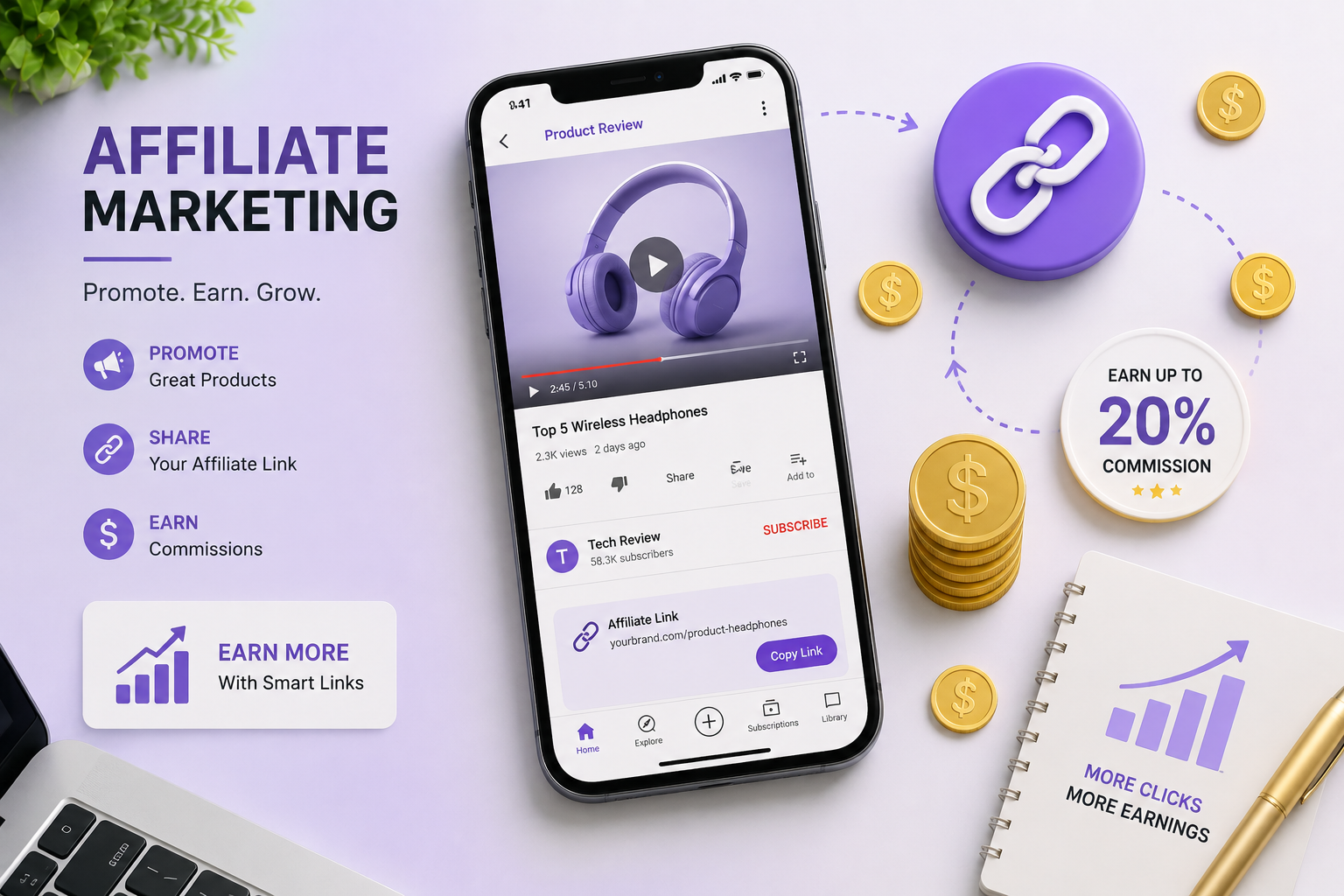
Affiliate marketing has one of those reputations that swings wildly depending on who you ask. To some, it’s a proven, legitimate way to build online income by recommending products you genuinely believe in. To others, it conjures up images of spammy “click this link” posts and inboxes full of low-effort promotions. The truth in 2026 sits closer to the first description, but only for the people who actually treat it like a real business.
Affiliate marketing hasn’t gone anywhere. If anything, it has become one of the more accessible entry points into online income, especially as content creation tools have improved and audiences have grown more comfortable discovering products through creators rather than traditional ads. But it has also become more competitive, and the tactics that worked a few years ago don’t carry the same weight today.
This guide will walk you through exactly what affiliate marketing looks like in 2026, how the money actually works, and how to build a strategy that has real staying power instead of chasing quick commissions that dry up within months.
What Is Affiliate Marketing, Exactly?
Affiliate marketing is a performance-based way of earning money by promoting other companies’ products or services. You share a unique tracking link, and when someone clicks that link and makes a purchase (or sometimes takes another qualifying action, like signing up for a free trial), you earn a commission.
It’s essentially digital word-of-mouth marketing, formalized with tracking and payment systems. Companies get new customers through trusted recommendations, and you get paid for driving those results, without ever needing to create your own product, manage inventory, or handle customer service.
Affiliate marketing typically happens through channels like:
- Blogs and websites
- YouTube videos
- Social media content, particularly short-form video
- Email newsletters
- Podcasts
- Comparison and review sites
- Coupon and deal platforms
The common thread across all of these is an audience that trusts your recommendations enough to act on them.
Is Affiliate Marketing Still Worth It In 2026?
Yes, though it’s worth understanding exactly how the landscape has shifted before diving in.
Audiences have become more skeptical of obvious promotion. Years of low-quality “top 10 products” listicles and clearly insincere recommendations have made people warier. Genuine, detailed, honest content now consistently outperforms generic promotional posts.
Short-form video has become a massive affiliate channel. Platforms like TikTok, Instagram Reels, and YouTube Shorts have created entirely new ways to drive affiliate sales, often through authentic product demonstrations and honest reviews rather than traditional written content alone.
AI has made content production faster, but also more crowded. It’s easier than ever to produce comparison articles and review content, which means differentiation through genuine expertise, testing, and original insight matters more than ever.
Programs and platforms have matured. Affiliate networks and individual brand programs have become more sophisticated, often offering better tracking, tiered commission structures, and more transparent reporting than in years past.
Niche authority beats broad promotion. Affiliates who focus deeply on one category and build real trust and expertise tend to significantly outperform those spreading themselves across many unrelated products.
In short, affiliate marketing in 2026 rewards depth, honesty, and genuine audience trust far more than it rewards volume or aggressive promotion.
How Affiliate Marketing Income Actually Works
Understanding the mechanics behind affiliate commissions helps you set realistic expectations and choose the right programs to promote.
Commission Structures
Affiliate programs typically pay through one of a few structures:
- Pay-per-sale – you earn a percentage of the sale price when someone purchases through your link
- Pay-per-lead – you earn a fixed amount when someone completes an action, like signing up for a free trial or filling out a form
- Pay-per-click – less common today, but some programs pay based on clicks generated, regardless of whether a sale occurs
- Recurring commissions – common with subscription-based products or software, where you continue earning as long as the referred customer remains subscribed
Recurring commission programs, particularly in software and digital subscription niches, have become increasingly popular among affiliates because they build predictable, compounding income over time rather than requiring constant new sales.
Cookie Duration
Most affiliate links use tracking cookies that credit you with a sale if it happens within a certain window after someone clicks your link, ranging anywhere from 24 hours to 90 days or more depending on the program. Longer cookie durations generally benefit affiliates, since not every visitor purchases immediately.
Average Commission Rates
Commission rates vary enormously by industry. Physical products, particularly through large marketplace affiliate programs, often pay relatively low percentages, sometimes in the low single digits. Digital products, software subscriptions, and online courses frequently offer significantly higher percentages, sometimes 30% to 50% or more, since there’s no manufacturing or shipping cost involved.
Choosing The Right Affiliate Niche
Your niche selection heavily influences both how much you can earn and how sustainable your affiliate business becomes. A strong niche in 2026 typically checks a few boxes:
- Genuine audience demand. People are actively searching for information, comparisons, or recommendations in this space.
- Products worth recommending. You can honestly stand behind what you’re promoting, which builds long-term trust rather than one-time clicks.
- Reasonable commission potential. Either through high-ticket items, high-percentage commissions, or recurring subscription models.
- Room for genuine expertise. Niches where you can develop real, demonstrable knowledge tend to outperform niches where you’re just repeating manufacturer descriptions.
Strong-performing affiliate niches in 2026 include:
- Software and SaaS tools – often high commissions with recurring revenue potential
- Personal finance products – budgeting apps, investment platforms, credit tools
- Health and wellness products – supplements, fitness equipment, wellness programs (approached carefully and honestly)
- Home and lifestyle products – smart home devices, organization tools, sustainable living products
- Online courses and education – often high commission percentages
- Travel – booking platforms, gear, and travel planning tools
- Beauty and personal care – strong visual appeal, well-suited to short-form video content
A simple way to validate a niche: search for products in that space alongside terms like “review,” “best,” or “vs,” and see whether other creators and websites are actively and successfully promoting similar products. Active competition, done well, is usually a sign of real demand rather than a reason to avoid a niche entirely.
Where To Find Affiliate Programs
There are generally two main paths for finding programs to join.
Affiliate Networks
Large networks aggregate thousands of individual brand programs in one place, offering centralized tracking, reporting, and payments. These are a great starting point for beginners since they make it easy to browse and compare options across many different companies at once.
Direct Affiliate Programs
Many companies, especially software and subscription-based businesses, run their own affiliate or “partner” programs directly, sometimes offering better commission rates or more personalized support than what you’d find through a larger network. Once you’ve built some track record, reaching out directly to brands you already use and love can sometimes unlock better terms than standard public programs.
Step-By-Step: How To Start Making Money With Affiliate Marketing
Step 1: Choose Your Niche And Primary Platform
Decide whether you’ll focus primarily on a blog, YouTube channel, social media, email list, or some combination. Beginners often find it easier to build momentum by focusing deeply on one primary platform before expanding.
Step 2: Build An Audience Around Genuine Value
Before worrying heavily about monetization, focus on creating content that genuinely helps your audience, whether that’s tutorials, honest reviews, comparisons, or educational content. Trust is the actual currency of affiliate marketing, and it has to be earned before it converts into commissions.
Step 3: Join Relevant Affiliate Programs
Once you have a content plan and initial audience, apply to affiliate programs relevant to your niche. Many programs have minimal requirements for approval, though some higher-paying or exclusive programs may want to see an established audience first.
Step 4: Create Genuinely Useful, Honest Content
The best-performing affiliate content in 2026 tends to include real testing, personal experience, honest pros and cons, and specific details that generic content mills can’t replicate. Comparison posts, in-depth reviews, and tutorial content that naturally incorporates product recommendations tend to convert particularly well.
Step 5: Disclose Clearly And Build Trust
Clear, upfront disclosure of affiliate relationships isn’t just a legal requirement in many regions, it also builds trust with your audience, who increasingly reward transparency over hidden promotion.
Step 6: Optimize For Conversions, Not Just Traffic
Getting visitors to your content is only half the equation. Thoughtful link placement, clear calls to action, and genuinely helpful context around your recommendations all significantly affect how many visitors actually click through and purchase.
Step 7: Diversify Your Traffic And Income Sources
Relying entirely on one traffic source, whether that’s search engines or a single social platform, leaves your income vulnerable to algorithm changes. Similarly, promoting a range of complementary products rather than depending on a single affiliate program protects your income if one program changes its terms or commission structure.
Step 8: Track Performance And Refine Over Time
Monitor which content, products, and platforms actually generate income, not just clicks or traffic. Double down on what’s working and phase out content or promotions that consistently underperform.
How Much Can You Realistically Earn?
Affiliate income varies enormously based on niche, audience size, and content quality. Many beginners earn very little in their first several months while they build audience trust and content volume. As an audience and content library grow, income tends to compound, since older content continues generating traffic and commissions long after it’s published.
Established affiliate marketers in higher-commission niches, particularly software and digital products with recurring commissions, can build substantial monthly income once they have a solid base of consistently performing content and an engaged audience. The key factor across almost every success story is consistency over a meaningful period of time, typically many months to a couple of years, rather than expecting significant income within the first few weeks.
Common Mistakes That Hold Affiliate Marketers Back
Promoting products you don’t actually believe in. Audiences can usually tell when a recommendation feels insincere, and it erodes trust that’s difficult to rebuild.
Spreading efforts across too many unrelated niches. Jumping between unrelated products and topics makes it harder to build the focused authority that drives real conversions.
Ignoring SEO and content depth. Thin, generic reviews rarely rank or convert as well as detailed, genuinely useful comparisons and guides.
Ignoring disclosure requirements. Failing to clearly disclose affiliate relationships can create legal issues and damage audience trust when discovered.
Focusing only on traffic, not conversion. High traffic with poor link placement, weak calls to action, or irrelevant product matches often underperforms a smaller, more targeted audience with well-optimized content.
Giving up too early. Affiliate income typically builds slowly at first and compounds over time as content accumulates and audience trust grows. Quitting after a few months, before that compounding effect kicks in, is one of the most common reasons people conclude affiliate marketing “doesn’t work.”
Relying on a single affiliate program. If a program changes its commission structure or shuts down, income tied entirely to that one source disappears overnight. Diversifying protects against this risk.
Is Affiliate Marketing Right For You?
Affiliate marketing tends to suit people who enjoy content creation, genuinely like researching and testing products, and are willing to build an audience over time rather than expecting instant results. It rewards patience, honesty, and a long-term content strategy far more than aggressive, high-volume promotion.
It’s probably not the right fit if you’re looking for guaranteed income with minimal upfront effort, or if you’re unwilling to disclose relationships transparently and only want to promote whatever pays the highest commission regardless of actual product quality. Sustainable affiliate income depends on genuine audience trust, and that trust takes real, consistent effort to build.
Final Thoughts
Affiliate marketing in 2026 remains a legitimate, accessible way to build online income, but it rewards a fundamentally different approach than it did in its earlier, less competitive years. Audiences have grown more discerning, search algorithms increasingly favor genuine depth and expertise, and short-form video has opened new doors for authentic, engaging product recommendations.
The affiliate marketers seeing real, sustainable success are the ones treating it as an actual content business: choosing a focused niche, genuinely testing and believing in what they recommend, building real audience trust, and diversifying both their traffic sources and their income streams. If you’re willing to invest the time to build that foundation properly, affiliate marketing remains one of the most flexible and scalable ways to earn money online in 2026.
Frequently Asked Questions
How much money can you make with affiliate marketing? It varies widely depending on niche, audience size, and content quality. Many beginners earn very little initially, while established affiliates with engaged audiences and diversified programs can build substantial, sometimes full-time, income over time.
Do I need a large audience to start affiliate marketing? Not necessarily. Some affiliates succeed with smaller, highly engaged niche audiences that convert well, since relevance and trust often matter more than sheer audience size.
What’s the easiest way to start affiliate marketing as a beginner? Starting with a blog or content platform focused on a niche you already know well, joining a beginner-friendly affiliate network, and focusing on genuinely helpful reviews or tutorials is typically the most accessible starting point.
How long does it take to start earning from affiliate marketing? Most affiliate marketers need several months to build enough content, traffic, and audience trust before seeing meaningful income, and income often compounds significantly after the first year of consistent effort.
Is affiliate marketing considered a legitimate business model? Yes. Affiliate marketing is a widely used, legal performance marketing model used by countless established companies and reputable creators, provided disclosures are handled transparently and honestly.