
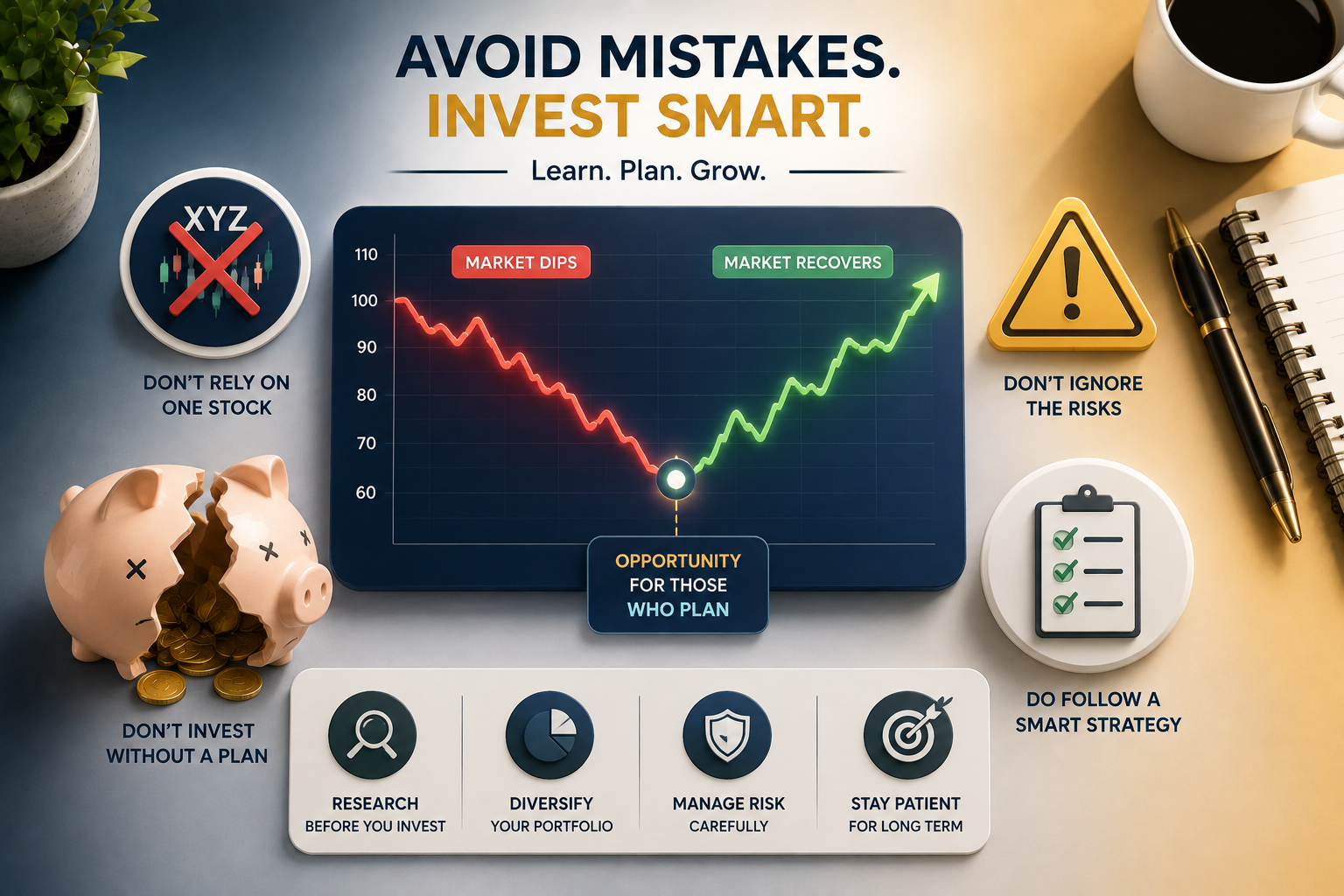
Every investor, no matter how successful they eventually become, starts out making mistakes. That’s not a warning, it’s just reality. The difference between beginners who build real wealth over time and those who get burned early on usually isn’t intelligence or luck. It’s whether they recognize the common traps before falling into them, or at least stop repeating them once they do.
2026 brings its own version of these mistakes. Social media has made investing advice louder and more accessible than ever, which sounds helpful until you realize a lot of that advice is either oversimplified, outdated, or flat-out wrong. Add in new tools like AI-powered trading apps, fractional shares, and endless finance influencers, and it’s easier than ever for a beginner to make a costly misstep without realizing it until much later.
This guide walks through ten of the most common and costly investing mistakes beginners make right now, why they happen, and what to do instead. None of this requires a finance degree. It just requires a bit of patience and a willingness to think a few steps ahead.
1. Waiting For The “Perfect” Time To Start
This is probably the single most common mistake, and it’s an easy trap to fall into. It feels responsible to wait for a market dip, a clearer economic outlook, or “more money saved up” before you start investing. In reality, waiting almost always costs more than it saves.
Here’s why. Investment growth compounds over time, meaning your money doesn’t just grow, it grows on top of its previous growth. Someone who starts investing modestly today has decades of potential compounding ahead of them. Someone who waits five years to find the “right moment” has permanently lost those five years of growth, no matter how good their eventual timing turns out to be.
Markets are inherently unpredictable in the short term. Even professional fund managers consistently fail to time the market accurately over the long run. Trying to guess the perfect entry point is far less reliable than simply starting now and staying consistent.
What to do instead: Start with whatever amount feels manageable today, even if it’s small. Time in the market matters far more than timing the market.
2. Putting All Your Money Into One Stock Or Trend
It’s tempting, especially when a stock or asset is generating buzz online, to go all in. Maybe it’s a hot tech stock, a trending cryptocurrency, or a company everyone on social media seems obsessed with. The problem is that concentrating your entire portfolio in a single investment exposes you to unnecessary risk.
Even strong, well-known companies can underperform, face unexpected setbacks, or decline sharply due to factors outside anyone’s control. If that one investment happens to be your entire portfolio, a single bad outcome can set you back significantly.
What to do instead: Diversify across multiple companies, sectors, and asset types. Low-cost index funds and ETFs make this easy by giving you exposure to dozens or hundreds of companies through a single investment, dramatically reducing the impact of any one company’s poor performance.
3. Panic Selling During Market Downturns
Markets go through cycles. Periods of growth are inevitably followed by corrections or downturns, and then eventually, recovery and further growth. This has been true throughout the entire history of modern markets. Yet every downturn brings a wave of beginner investors who sell everything out of fear, locking in real losses on what would otherwise have been a temporary dip.
The irony is that selling during a downturn guarantees a loss, while staying invested gives your portfolio the chance to recover and continue growing once the market stabilizes, which it historically always has, even after severe downturns.
What to do instead: Before you invest, mentally prepare for the fact that downturns will happen. Having a long-term plan and a diversified portfolio makes it much easier to ride out volatility without panicking.
4. Chasing Whatever Is Trending On Social Media
Finance content has exploded across social platforms, and while some of it is genuinely educational, a lot of it is driven by hype, sponsored promotion, or creators who simply got lucky once and are now presenting themselves as experts. In 2026, AI-generated financial content has made this problem even more pronounced, with convincing but shallow advice circulating widely.
Jumping into whatever investment is trending, without understanding the underlying fundamentals, risk level, or your own financial situation, is a fast way to lose money. By the time an investment is trending widely enough for the average person to hear about it, much of the easy growth potential may have already happened, and the risk of a correction is often higher.
What to do instead: Treat social media as a starting point for research, not a final source of truth. Verify claims independently, understand what you’re actually investing in, and be especially cautious of anything promising guaranteed or unusually high returns.
5. Ignoring Fees And Expense Ratios
Fees can feel invisible, especially small percentage-based fees that don’t show up as an obvious dollar amount deducted from your account. But over decades, even seemingly minor fee differences compound into a significant amount of lost growth.
Actively managed funds, frequent trading, and certain platforms often carry higher fees than low-cost index funds or ETFs. A fund with a noticeably higher expense ratio needs to outperform a lower-cost alternative just to deliver the same net return to you, and most actively managed funds fail to consistently do so over the long term.
What to do instead: Compare expense ratios and account fees before choosing investments or platforms. Favor low-cost, diversified funds when possible, and be mindful of transaction fees if you trade frequently.
6. Investing Before Building Any Financial Cushion
Investing is exciting, and it’s tempting to jump in immediately once you learn how accessible it’s become. But investing without any emergency savings or while carrying high-interest debt can backfire badly.
If an unexpected expense comes up and you don’t have accessible savings, you might be forced to sell investments at an inopportune time, potentially at a loss, just to cover the emergency. Similarly, if you’re paying high interest on credit card debt while your investments are earning a more modest average return, the math often doesn’t favor investing yet.
What to do instead: Build at least a small emergency fund covering a few months of essential expenses, and prioritize paying down high-interest debt before investing aggressively. This creates a more stable foundation for your investing journey.
7. Trying To Time The Market Instead Of Staying Consistent
Related to mistake number one, but distinct enough to call out separately: many beginners don’t just wait to start investing, they continue trying to time individual purchases and sales once they’re already invested. This often means buying when prices feel “safe” after a rally and selling or avoiding buying during dips, which is essentially the opposite of a sound long-term strategy.
Consistently trying to predict short-term market movements is extremely difficult, even for professional investors with far more resources and information than an individual beginner typically has access to.
What to do instead: Consider a dollar-cost averaging approach, investing a fixed amount at regular intervals regardless of market conditions. This removes emotional decision-making and smooths out the impact of volatility over time.
8. Neglecting Employer Retirement Matches And Tax-Advantaged Accounts
This mistake is less about taking on unnecessary risk and more about leaving free, guaranteed value on the table. Many employers offer matching contributions on workplace retirement accounts up to a certain percentage of your income. Skipping this, especially in favor of investing through a regular taxable account instead, means missing out on essentially free money.
Similarly, many beginners overlook the tax advantages available through retirement-specific accounts, which can meaningfully boost long-term growth compared to investing the same amount in a standard taxable account.
What to do instead: If your employer offers a matching retirement contribution, aim to contribute at least enough to capture the full match before directing money elsewhere. Understand the tax-advantaged account options available to you and take advantage of them where it makes sense for your situation.
9. Overcomplicating Your Strategy Too Early
With so much investing content available in 2026, from options trading tutorials to complex portfolio theories, it’s easy for beginners to feel like they need an elaborate, sophisticated strategy right out of the gate. In reality, overly complex strategies often introduce more risk and more room for costly mistakes, without necessarily producing better returns than a simpler approach.
Many of the most successful long-term investors rely on relatively simple, diversified, low-cost strategies rather than constantly trading or chasing complex tactics.
What to do instead: Start simple. A diversified portfolio of low-cost index funds or ETFs, held consistently over time, is a reasonable and effective strategy for most beginners. You can always learn more and adjust your approach as your knowledge and confidence grow, but there’s no need to start complicated.
10. Not Having Clear Goals Or A Defined Time Horizon
Investing without a clear purpose makes almost every other decision harder. Without knowing whether you’re investing for retirement decades away, a home purchase in a few years, or general long-term wealth building, it’s difficult to choose an appropriate level of risk or the right mix of investments.
This lack of clarity also makes it easier to make emotional, reactive decisions, since you don’t have a defined plan to fall back on when the market gets volatile or a trend catches your attention.
What to do instead: Take time to define your specific financial goals and realistic timelines for each one. Your investment choices, and your appropriate risk level, should flow directly from those goals rather than from whatever feels exciting in the moment.
Why These Mistakes Matter More In 2026 Specifically
Investing itself hasn’t fundamentally changed, but the environment beginners are investing in has shifted in ways that make some of these mistakes easier to fall into.
Investment platforms have become extremely easy to use, sometimes to a fault, making impulsive trades just a few taps away. Social media and AI-generated financial content have amplified both good information and confident-sounding misinformation in equal measure, making it harder for beginners to distinguish reliable guidance from hype. And with more asset types than ever, including cryptocurrency and various alternative investments, beginners face more tempting distractions from a straightforward, diversified, long-term strategy than investors did a decade or two ago.
None of this means investing has become inherently more dangerous. It means beginners need to be a bit more intentional about filtering out noise and sticking to fundamentals that have remained reliable for decades.
A Simple Framework To Avoid Most Of These Mistakes
If ten separate mistakes feel like a lot to keep track of, most of them actually boil down to a few core principles:
- Start now, even small. Time in the market beats waiting for perfect timing.
- Diversify instead of concentrating. Spread your investments across multiple companies and asset types.
- Stay invested through volatility. Downturns are normal and historically temporary for diversified, long-term portfolios.
- Keep costs low. Fees quietly erode returns over time, so favor low-cost, diversified options.
- Build a foundation first. A small emergency fund and manageable debt levels make investing far less stressful.
- Define your goals. Clear goals make every other investing decision easier and less emotional.
If you keep these six principles in mind, you’ll naturally sidestep most of the ten mistakes covered above without needing to memorize a long checklist every time you make an investing decision.
Final Thoughts
Every investor makes mistakes at some point, and that’s completely normal. What separates beginners who build real long-term wealth from those who get discouraged and quit is usually not talent or luck, but a willingness to learn from common pitfalls before repeating them too many times.
The good news is that avoiding these ten mistakes doesn’t require complicated financial knowledge or constant market monitoring. It mostly requires patience, consistency, and a clear plan you can stick to even when social media, market headlines, or short-term volatility try to convince you otherwise. Start where you are, keep your strategy simple and diversified, and give your investments the time they need to grow.
Frequently Asked Questions
What is the biggest mistake beginner investors make? Waiting for the “perfect” time to start is one of the most common and costly mistakes, since it sacrifices valuable time that could otherwise be spent benefiting from compound growth.
Is it risky to invest as a complete beginner in 2026? All investing carries some level of risk, but starting with a diversified, low-cost approach and avoiding common mistakes like concentrating in a single asset or panic selling significantly reduces unnecessary risk for beginners.
How can beginners avoid falling for hype-driven investment trends? Treat trending investments with healthy skepticism, research the underlying fundamentals independently, and be especially cautious of anything promising guaranteed or unusually high returns.
Should beginners avoid investing until their debt is fully paid off? Not necessarily, but it’s generally wise to prioritize paying off high-interest debt and building a small emergency fund before investing aggressively, since high-interest debt often outpaces typical investment returns.
Is a simple investing strategy really enough for long-term success? Yes, for most beginners, a diversified, low-cost, consistent investing strategy tends to outperform more complicated approaches, especially once fees and the risk of costly mistakes are taken into account.