
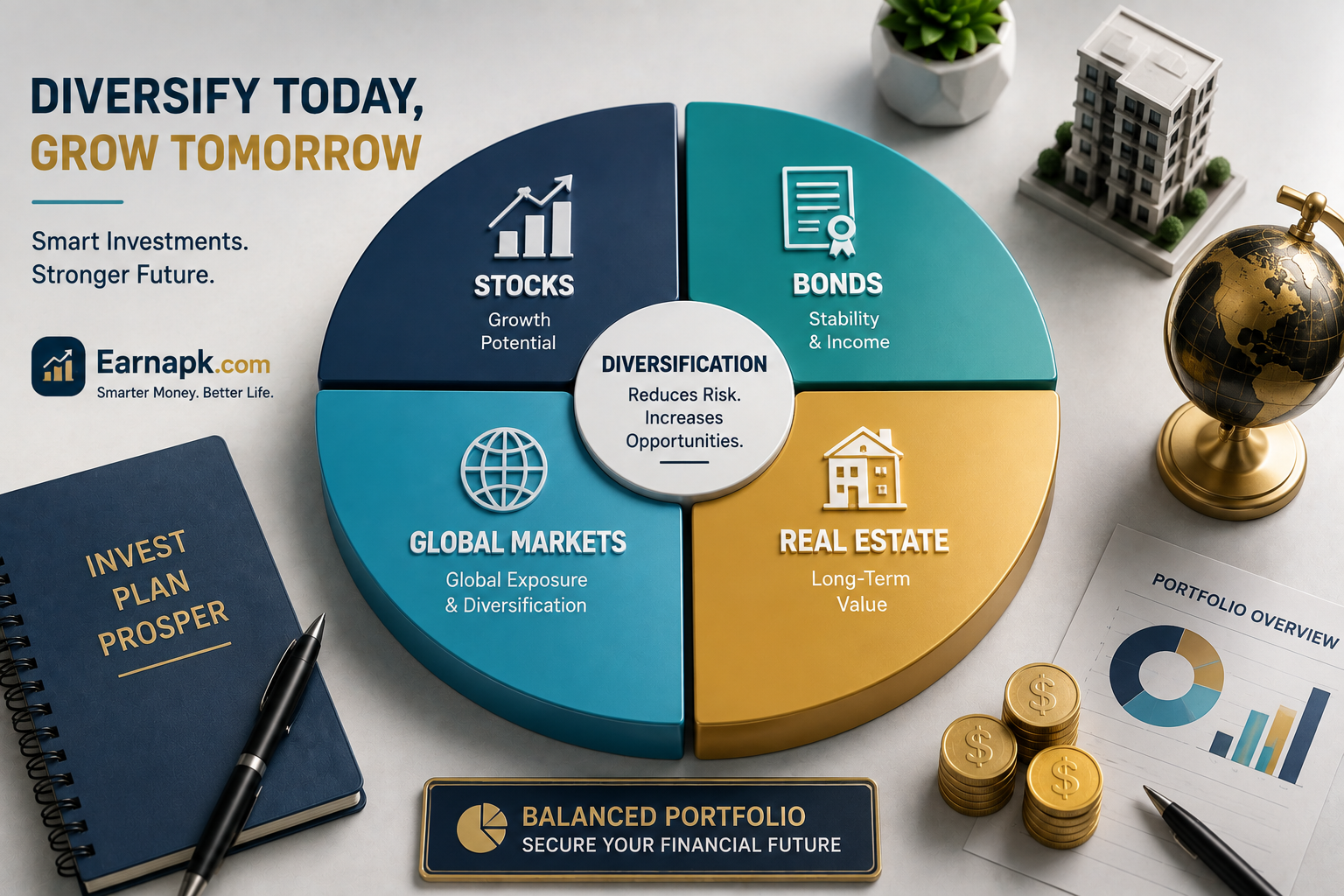
There’s an old saying in investing that gets repeated so often it almost loses meaning: don’t put all your eggs in one basket. But once you actually understand why that advice exists, it stops sounding like a cliché and starts sounding like common sense. If one basket falls, and all your eggs are in it, you lose everything. Spread those eggs across several baskets, and one bad drop won’t wipe you out.
That’s diversification in a nutshell. It’s not about being overly cautious or missing out on growth. It’s about building a portfolio that can weather the inevitable ups and downs of the market without derailing your long-term goals every time one investment has a rough year. The good news is that diversifying doesn’t require a finance degree or a complicated strategy. In 2026, there are more beginner-friendly tools than ever to help you spread your risk intelligently, even if you’re starting with a modest amount of money.
Let’s walk through seven practical, accessible ways to diversify your investments, without the jargon-heavy explanations that make this topic feel more intimidating than it needs to be.
Why Diversification Matters More Than You Might Think
Before getting into the specific strategies, it’s worth understanding what diversification actually protects you from.
It reduces the impact of any single investment performing badly. If your entire portfolio sits in one company’s stock and that company hits a rough patch, your whole financial future takes the hit with it. Spread across many investments, one poor performer has a much smaller effect on your overall portfolio.
It smooths out volatility over time. Different asset types often move differently in response to the same economic conditions. When stocks dip, bonds sometimes hold steady or even rise, helping balance out your overall returns.
It allows you to stay invested through market swings. A well-diversified portfolio tends to be less stressful to hold onto during downturns, which matters because panic selling during a dip is one of the most common ways investors lock in losses that would have otherwise recovered.
It doesn’t require sacrificing long-term growth. Diversification isn’t about avoiding risk altogether. It’s about managing risk intelligently so you can stay invested confidently for the long haul, which is ultimately what drives real wealth building.
With that foundation in place, here are seven practical ways to diversify, even as a beginner.
1. Start With Broad Index Funds Or ETFs
If you only take one piece of advice from this entire article, let it be this one. Index funds and exchange-traded funds (ETFs) are collections of many different stocks or bonds bundled into a single investment, giving you instant diversification without needing to research and pick individual companies yourself.
Instead of trying to guess which single company will outperform the market, a broad market index fund lets you own a small slice of hundreds or even thousands of companies at once. If a handful of those companies struggle, the overall fund is far less affected than a single stock would be.
For beginners, this is often the simplest and most effective diversification strategy available. It requires minimal ongoing management, keeps fees relatively low, and provides exposure to overall market growth rather than betting everything on individual stock picks.
A common beginner-friendly approach is starting with a total market or broad index fund that tracks a wide swath of the stock market, giving you diversification across industries and company sizes right out of the gate.
2. Mix In Bonds To Balance Out Stock Market Risk
Stocks tend to offer higher long-term growth potential, but they also come with more short-term volatility. Bonds, on the other hand, are generally more stable and provide predictable interest payments, though typically with lower long-term returns.
Including bonds in your portfolio helps cushion the impact of stock market downturns. When stocks drop significantly, a portion of your portfolio held in bonds can help offset some of those losses, keeping your overall balance more stable.
How much of your portfolio should be in bonds versus stocks depends largely on your time horizon and risk tolerance. Younger investors with decades until retirement can often afford to lean more heavily toward stocks, since they have more time to recover from downturns. Investors closer to needing their money, such as those nearing retirement, often shift toward a higher bond allocation to protect what they’ve already built.
Bond funds and ETFs make this easy for beginners, offering diversified exposure to many different bonds without needing to purchase individual ones yourself.
3. Explore Real Estate Without Buying Property Directly
Real estate has long been considered a smart diversification tool, since property values and rental income don’t always move in the same direction as the stock market. But buying physical property requires significant capital, ongoing management, and a level of commitment many beginners aren’t ready for.
Real estate investment trusts (REITs) solve this problem. REITs are companies that own or finance income-producing real estate, and they trade on the stock market just like regular stocks. Buying shares in a REIT allows you to invest in real estate markets, from apartment complexes to commercial properties, without needing to buy, manage, or maintain any property yourself.
REITs also often pay regular dividends, since they’re required to distribute a significant portion of their income to shareholders, making them appealing for investors interested in both diversification and income generation.
For beginners, real estate-focused ETFs or REIT funds offer an easy way to add property exposure to a portfolio with the same simplicity as buying a regular stock or fund.
4. Diversify Across Different Industries And Sectors
Even within the stock portion of your portfolio, it’s worth paying attention to industry diversification. If a large share of your investments sits in a single sector, such as technology or energy, your portfolio becomes more vulnerable to downturns specific to that industry.
Broad market index funds typically already provide solid sector diversification, since they include companies across healthcare, technology, finance, consumer goods, energy, and more. But if you’re also investing in individual stocks, it’s worth periodically checking whether your holdings are too concentrated in one or two sectors.
Sector-specific ETFs can also be used intentionally, either to add targeted exposure to an industry you believe in or to balance out an overconcentration elsewhere in your portfolio. The goal isn’t to avoid any single sector entirely, but to make sure no single industry’s performance can single-handedly make or break your entire portfolio.
5. Add International Exposure To Your Portfolio
It’s easy to focus exclusively on domestic markets, especially if that’s what feels most familiar. But limiting your investments to a single country’s economy means your portfolio’s performance is tied entirely to that country’s economic conditions, regulations, and market cycles.
International index funds and ETFs allow you to invest in companies based in other countries and regions, spreading your exposure across multiple economies rather than just one. This can help balance out periods when your home market underperforms, since different countries and regions don’t always move in sync with each other economically.
For beginners, a simple international index fund covering developed or emerging markets can add meaningful geographic diversification without requiring you to research individual foreign companies or navigate unfamiliar markets on your own.
6. Consider Small Allocations To Alternative Assets
Alternative assets, such as commodities like gold, or newer options like cryptocurrency, have become increasingly accessible to everyday investors. These assets sometimes behave differently than traditional stocks and bonds, particularly during certain economic conditions, which can add another layer of diversification to a portfolio.
That said, alternative assets generally carry higher volatility and risk than traditional investments, and they shouldn’t form the foundation of a beginner’s portfolio. Many financial professionals suggest keeping alternative asset allocations relatively small, treating them as a supplementary piece of a broader, more traditional diversified strategy rather than a primary investment approach.
If you’re interested in exploring alternative assets, doing so cautiously and with money you can afford to see fluctuate significantly is a reasonable approach, rather than treating them as a guaranteed diversification solution.
7. Use Target-Date Or Balanced Funds For Built-In Diversification
If choosing and balancing individual funds feels overwhelming, target-date funds and balanced funds offer a genuinely beginner-friendly shortcut.
Target-date funds are designed around a specific future date, often a planned retirement year, and automatically adjust their mix of stocks and bonds over time, gradually shifting toward a more conservative allocation as that target date approaches. This means the diversification and rebalancing work is handled for you, making it one of the simplest hands-off investment options available.
Balanced funds work similarly, maintaining a set mix of stocks and bonds designed to provide diversification and moderate risk without requiring you to manage the allocation yourself.
For beginners who want solid diversification without needing to actively manage multiple individual investments, these fund types offer a practical, low-maintenance starting point.
How To Actually Build A Diversified Portfolio As A Beginner
Understanding these seven strategies is helpful, but putting them together into an actual portfolio is where the real value comes in. Here’s a simple approach for beginners.
Start with your time horizon and risk tolerance. This shapes how much of your portfolio should lean toward growth-focused assets like stocks versus more stable assets like bonds.
Choose a core, broad-based index fund or ETF as your foundation. This single investment already provides substantial diversification across industries and companies.
Layer in bonds appropriate to your time horizon. A younger investor with decades until retirement might keep a smaller bond allocation, while someone closer to their goal might increase it.
Add international exposure for geographic diversification. Even a modest allocation to international funds can meaningfully reduce your portfolio’s dependence on a single country’s market performance.
Consider REITs for real estate exposure without direct property ownership. This adds another asset type that doesn’t always move in sync with the broader stock market.
Keep alternative assets, if you choose to include them, as a small portion of your overall portfolio. Treat these as a supplement to your diversified foundation, not a replacement for it.
Rebalance periodically. Over time, some investments will grow faster than others, shifting your original allocation. Periodically adjusting your portfolio back to your intended balance helps maintain your diversification strategy as market conditions change.
Common Diversification Mistakes Beginners Make
Confusing owning many stocks with true diversification. Owning ten different technology stocks isn’t meaningfully diversified if they all react similarly to the same industry trends. Real diversification spans different asset types, sectors, and geographic regions.
Over-diversifying to the point of diminishing returns. While diversification is important, spreading your money across an excessive number of overlapping funds can create unnecessary complexity without meaningfully reducing risk further.
Ignoring diversification within retirement accounts. Some beginners diversify their taxable brokerage accounts carefully while leaving their retirement accounts concentrated in a single fund or company stock, unintentionally undermining their overall strategy.
Treating alternative assets as a primary diversification strategy. Alternative assets like cryptocurrency carry significant volatility and shouldn’t replace a solid foundation of traditional diversified investments.
Never rebalancing. A portfolio that was well diversified a few years ago can become unintentionally concentrated over time if left unchecked, especially after strong growth in one particular asset type.
Letting fear drive allocation decisions instead of strategy. Reacting to short-term market headlines by drastically shifting your diversification strategy often does more harm than good compared to sticking with a thoughtful, long-term approach.
Final Thoughts
Diversification isn’t a complicated, advanced-level investing concept reserved for people with large portfolios and years of experience. It’s one of the most beginner-friendly, practical tools available for managing risk while still giving your money real opportunity to grow. Broad index funds, a thoughtful mix of stocks and bonds, some real estate and international exposure, and a cautious approach to alternative assets can go a long way toward building a portfolio that can weather market ups and downs without keeping you up at night.
You don’t need to implement all seven of these strategies at once, and you certainly don’t need to get it perfect from day one. Start with a solid, diversified foundation, add complexity gradually as you learn and grow more comfortable, and rebalance periodically to keep your portfolio aligned with your goals. Diversification won’t guarantee you avoid every dip or downturn, but it significantly improves your odds of staying invested confidently for the long run, which is ultimately what builds lasting wealth.
Frequently Asked Questions
How many investments do I need to be properly diversified? There’s no exact number, but a broad index fund alone can provide substantial diversification across hundreds of companies. Adding a few complementary asset types, such as bonds, international funds, and REITs, typically creates a well-rounded, diversified portfolio without requiring dozens of separate holdings.
Is diversification only important for large portfolios? No. Diversification matters at every portfolio size, and many beginner-friendly funds allow you to achieve meaningful diversification even with a small initial investment.
Does diversification mean I’ll never lose money? No. Diversification reduces risk and smooths out volatility, but it doesn’t eliminate the possibility of losses, especially during broad market downturns that affect most asset types simultaneously.
How often should I rebalance my diversified portfolio? Many investors rebalance once or twice a year, or whenever their allocation drifts significantly from their original target due to some investments growing faster than others.
Are target-date funds a good diversification option for beginners? Yes. Target-date funds handle diversification and gradual risk adjustment automatically, making them a practical, low-maintenance option for beginners who want solid diversification without actively managing multiple individual investments.