
If there’s one financial concept that separates people who build real wealth from people who spend decades wondering where their money went, it’s compound interest. It sounds simple, almost boring, when you first hear it explained. Your money earns returns, and then those returns start earning returns of their own. But the actual impact of that idea, especially over long stretches of time, is one of the most powerful forces in personal finance.
Here’s the part that surprises most people: how much money you start with matters far less than when you start. Someone who invests a modest amount in their twenties can end up with significantly more money by retirement than someone who invests a much larger amount starting in their forties, simply because of the extra years compounding had to work.
This article breaks down exactly how compound interest works, why time is the single most valuable ingredient in the equation, and how to actually use this knowledge to make smarter financial decisions starting today, regardless of your age or current income.
What Is Compound Interest, Really?
Compound interest is the process of earning returns not just on your original investment, but also on the returns that investment has already generated. In simple terms, your money starts making money, and then that new money starts making money too.
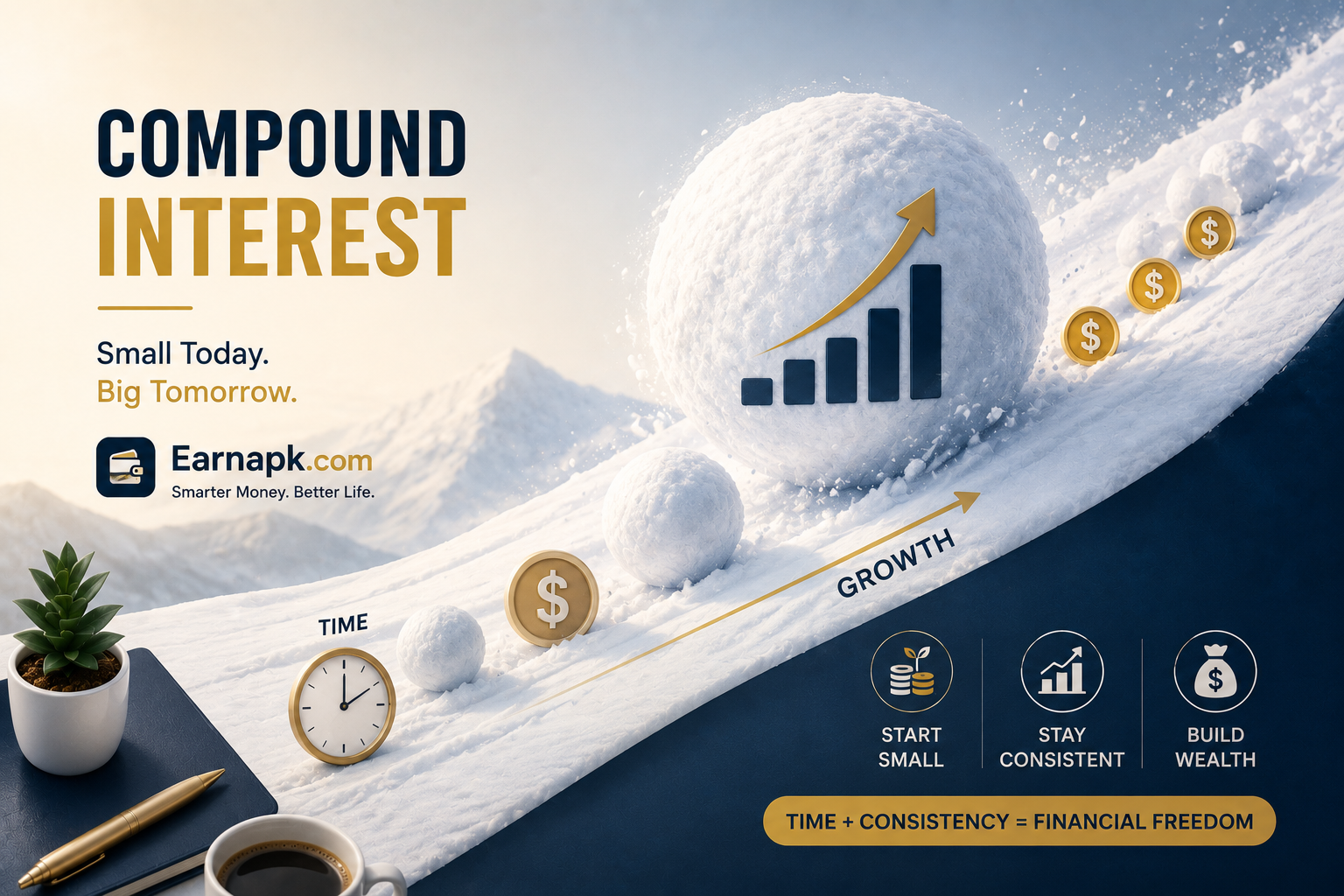
Compare this to simple interest, where you only earn returns on your original amount, year after year, with no acceleration. Compound interest, by contrast, creates a snowball effect. It starts small and unremarkable, but the longer it rolls, the faster it grows.
Here’s a basic example. Imagine you invest $1,000 and it grows at 8% per year.
With simple interest, you’d earn $80 every single year, no more, no less, based only on your original $1,000.
With compound interest, your first year also earns $80, bringing your total to $1,080. But in year two, you earn 8% on $1,080, not just the original $1,000, giving you $86.40 instead of $80. That extra $6.40 might look insignificant on its own, but stretched across decades, this compounding effect becomes dramatically more powerful.
The Formula Behind Compound Interest (Without The Headache)
You don’t need to memorize complex math to understand compound interest conceptually, but it helps to know the basic formula that governs it:
A = P (1 + r/n)^(nt)
Where:
- A is the final amount
- P is your original principal (starting amount)
- r is your annual interest rate (as a decimal)
- n is how many times interest compounds per year
- t is the number of years your money stays invested
The details matter less than the core takeaway: time (t) is an exponent in this formula, not just a regular multiplier. That means time doesn’t just add to your returns, it multiplies them exponentially. This is exactly why an extra ten years of investing early in life can outweigh even significantly larger contributions made later.
Why Starting Early Beats Starting Big: A Real Comparison
Let’s walk through a comparison that illustrates this concept clearly, using two hypothetical investors.
Investor A starts investing $200 per month at age 25 and stops contributing entirely at age 35, letting the money sit and grow untouched until age 65. That’s just 10 years of contributions, totaling $24,000 invested.
Investor B waits until age 35 to start investing and contributes the same $200 per month consistently for 30 years, until age 65. That’s $72,000 invested, three times more money out of pocket than Investor A.
Assuming both accounts earn an average 8% annual return, here’s the striking part: Investor A, despite investing far less money overall and stopping contributions after just 10 years, often ends up with a similar or even larger final balance than Investor B by age 65. The extra decade of compounding time for Investor A’s early contributions outweighs the significantly larger total amount Investor B contributed later.
This is the entire argument for starting early, illustrated in the clearest way possible. It’s not about how much money you can throw at investing right now. It’s about how many years you give that money to grow.
The Three Ingredients That Drive Compound Growth
Understanding compound interest more deeply comes down to three key variables working together.
1. Time
Time is, without question, the most powerful ingredient in the compounding equation, precisely because of its exponential effect in the formula above. Every additional year your money stays invested doesn’t just add value, it multiplies the growth already built up in previous years.
2. Rate Of Return
The percentage your investments earn annually obviously matters, and even small differences compound significantly over long periods. A portfolio earning 7% annually versus 9% annually might not sound like a huge gap year to year, but over several decades, that difference can result in a dramatically different final balance.
3. Consistency Of Contributions
While a single lump sum can absolutely benefit from compounding, consistently adding new contributions over time accelerates growth even further, since each new contribution also gets its own runway to compound.
Of these three factors, time is the one that’s hardest to make up for later. You can adjust your contribution amount or seek a slightly better rate of return relatively easily, but you can never manufacture more years once they’ve already passed.
Why “I’ll Start Later” Is The Costliest Financial Decision Most People Make
Delaying investing feels harmless in the moment. A few years won’t matter much, right? Unfortunately, this is exactly where compound interest becomes unforgiving. Because growth compounds exponentially rather than linearly, the years closest to when you eventually retire or reach your goal are actually the least powerful ones for growth. The early years, the ones that feel most tempting to skip while you “get settled” financially, are disproportionately valuable specifically because they have the most time left to compound.
Waiting even five or ten years to start investing doesn’t just delay your progress by that same number of years. Because of the exponential nature of compounding, it can end up costing you a significantly larger portion of your total potential growth than the delay itself would suggest.
This doesn’t mean it’s ever too late to start. It’s not. But it does mean that today, whatever your current age or financial situation, is a better time to start than next year.
How To Put Compound Interest To Work In Real Life
Understanding compound interest conceptually is one thing. Actually using it effectively is another. Here’s how to apply it practically.
Start With Whatever Amount You Can, Even If It’s Small
Many people delay investing because they feel like their contribution amount isn’t significant enough to matter. This is one of the most costly misconceptions in personal finance. A small, consistent contribution started early almost always outperforms a larger contribution started later, simply because of the extra compounding time involved.
Prioritize Consistency Over Perfection
You don’t need to invest a huge amount every single month to benefit meaningfully from compound growth. Automating even modest, regular contributions ensures your money is continuously given new time to compound, rather than waiting for some ideal moment that may never arrive.
Take Advantage Of Tax-Advantaged Accounts
Retirement accounts that offer tax-deferred or tax-free growth allow your compounding to work even more efficiently, since you’re not losing a portion of your returns to taxes along the way. Employer matching contributions, where available, essentially accelerate your compounding even further by adding free money to your invested principal.
Reinvest Your Returns Rather Than Withdrawing Them
Dividends, interest payments, and other investment income should generally be reinvested rather than spent, particularly during your accumulation years. Reinvesting ensures those returns immediately start compounding themselves, rather than sitting idle or being spent.
Avoid Interrupting The Compounding Process
Frequently withdrawing from your investments, or pausing contributions for long stretches, disrupts the compounding snowball and can meaningfully reduce your long-term growth, even if the interruptions feel minor at the time.
Extend Your Time Horizon Whenever Possible
If you’re able to leave a portion of your investments untouched for a longer period, even a few additional years can produce a meaningfully larger final balance, thanks to the exponential nature of compound growth.
Compound Interest Works Against You Too
It’s worth mentioning that compound interest isn’t only a wealth-building tool. It works in reverse when it comes to debt, particularly high-interest debt like credit cards. Just as your investments can grow exponentially over time, unpaid debt balances can grow exponentially too, as interest accumulates not just on your original balance, but on previously accrued interest as well.
This is exactly why paying off high-interest debt is often prioritized before aggressive investing. Compound interest working against you, in the form of growing debt, can easily outpace the returns you’d otherwise be earning by investing that same money instead.
Common Misconceptions About Compound Interest
“I need a lot of money to start.” In reality, starting with a small, consistent amount early on often outperforms waiting until you have a larger sum to invest.
“A few years’ delay won’t make a significant difference.” Because of the exponential nature of compounding, even a relatively short delay in your investing timeline can meaningfully reduce your long-term growth potential.
“Compound interest only matters for retirement.” While retirement is the most common example, compound growth applies to any long-term financial goal, including saving for a home, education, or general long-term wealth building.
“Higher returns always matter more than starting early.” While a higher rate of return certainly helps, time is generally the more powerful and more reliable factor, since chasing higher returns often comes with significantly higher risk.
“It’s too late for me to benefit from compound interest.” While starting earlier is always more advantageous, compound growth still meaningfully benefits investors starting later in life. The best time to start was years ago; the second best time is today.
A Simple Mental Model To Remember
If there’s one way to internalize the power of compound interest, it’s this: think of your money as a snowball rolling down a long hill. In the beginning, the snowball is small and barely seems to be growing. But the longer it rolls, the more surface area it has to pick up additional snow, and the faster it grows with each passing moment.
If you start rolling that snowball from the very top of the hill, even a small one has enormous room to grow by the time it reaches the bottom. If you start halfway down instead, even a much larger starting snowball simply doesn’t have enough hill left to catch up to where the early starter’s snowball ends up.
This is exactly why financial advisors consistently emphasize starting as early as possible, even with modest amounts, rather than waiting until you feel financially “ready” to invest significant sums.
Final Thoughts
Compound interest rewards patience and consistency far more than it rewards large lump sums or perfect timing. The most important variable in the entire equation isn’t how much money you start with, it’s how much time you give that money to grow. Every year you delay isn’t just a year lost; because of the exponential nature of compounding, it often represents a disproportionately large share of your total potential growth.
If you haven’t started investing yet, the most valuable thing you can do today isn’t waiting until you have more money saved up. It’s starting now, even modestly, and letting time do what it does best. If you’ve already started, the best move is simply staying consistent and giving your money as much uninterrupted time as possible to keep compounding.
The snowball only grows as long as it keeps rolling. The sooner you start it moving, the further it can go.
Frequently Asked Questions
What’s the difference between compound interest and simple interest? Simple interest is calculated only on your original principal amount every period, while compound interest is calculated on both your original principal and any previously earned returns, creating exponential rather than linear growth over time.
How often should interest compound to make a real difference? Compounding frequency, whether daily, monthly, or annually, does affect your final returns, but the difference is generally much smaller than the impact of your overall time horizon and consistency of contributions.
Is it ever too late to benefit from compound interest? No. While starting earlier is always more advantageous, compound growth still provides meaningful benefits at any age. The most important step is simply starting as soon as possible, regardless of your current age.
Can compound interest work against me? Yes, particularly with high-interest debt like credit cards, where unpaid balances can grow exponentially over time in the same way investments do. This is why paying down high-interest debt is often prioritized before aggressive investing.
Do I need a large amount of money to take advantage of compound interest? No. Starting with a small, consistent contribution early on is often more effective than waiting to invest a larger amount later, precisely because of the additional time your money has to compound.