
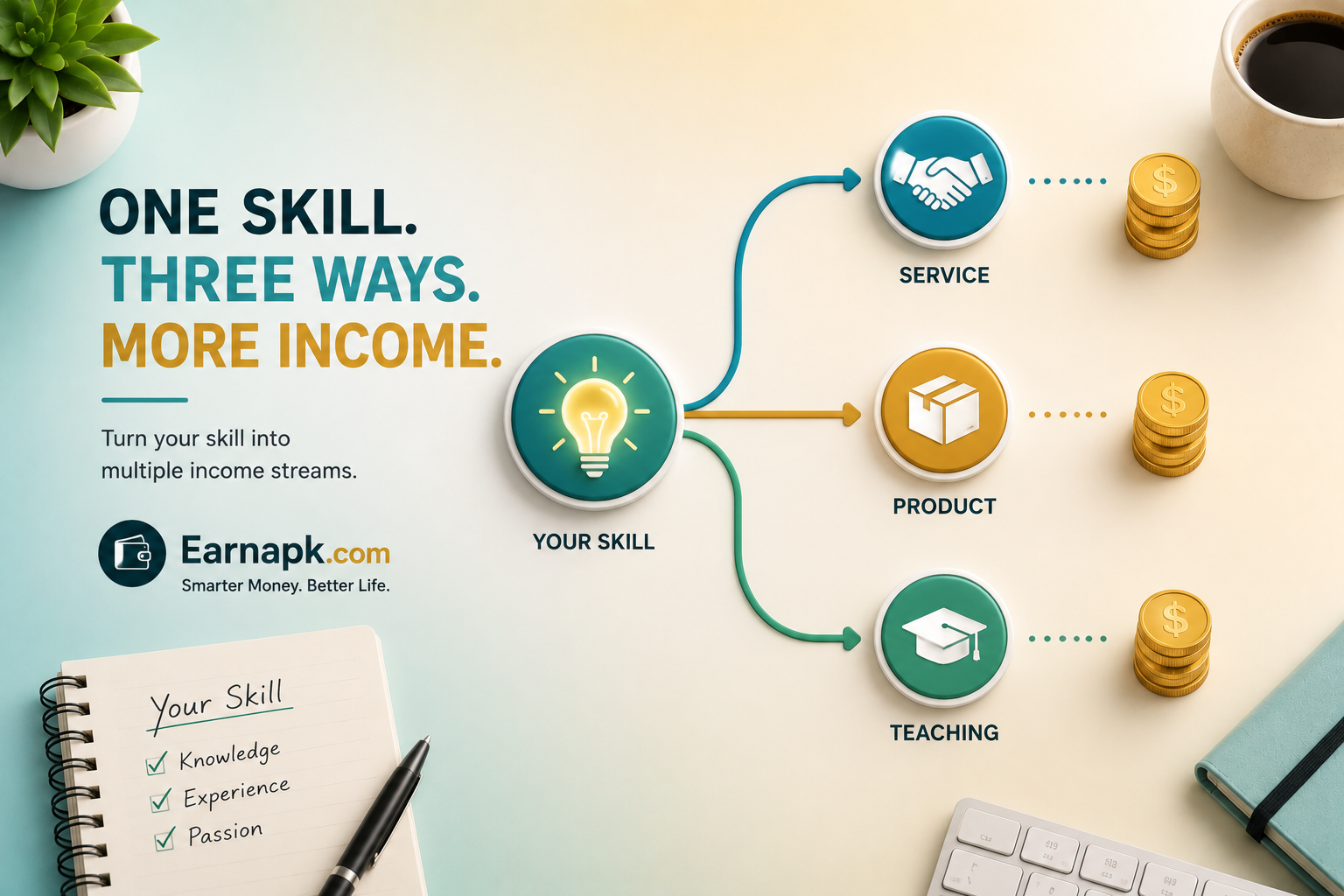
Most people think diversifying their income means learning a completely new skill for every new revenue stream. Learn design, then also learn coding, then also learn marketing, stacking unrelated abilities like a resume built out of desperation. But that’s not how the people with genuinely resilient incomes actually operate. They tend to go deep on one skill and then find multiple different ways to sell it.
One skill, applied through different formats and to different audiences, can quietly become three, four, or even five separate income streams. A writer doesn’t need to learn graphic design to diversify their income. They need to recognize that writing can be sold as a service, packaged as a product, and taught as a skill, all from the same underlying expertise. This guide walks through exactly how to do that, using a practical framework you can apply to almost any skill you already have.
Let’s break it down.
Why One Skill Beats Five Random Ones
There’s a strong temptation, especially early on, to chase income diversity by picking up a pile of unrelated skills. The logic seems sound: more skills should mean more opportunities. In practice, it usually backfires.
Depth compounds, breadth dilutes. Spending years becoming genuinely excellent at one skill builds real expertise, a reputation, and results you can point to. Spreading yourself across five beginner-level skills usually means being mediocre at all of them, which makes it harder to charge premium rates or stand out in any single area.
Your existing audience and reputation transfer. If people already know you for one thing, it’s far easier to sell them a related product, service, or resource built on that same expertise than to convince them you’re suddenly credible in something completely different.
Systems and knowledge reuse across income streams. When your income streams all stem from one core skill, the research, content, templates, and client relationships you build for one stream often directly support the others, saving enormous time compared to building unrelated businesses from scratch.
It’s easier to become known for something specific. “The person who does everything” is forgettable. “The person who’s exceptional at one particular thing” is memorable, referable, and easier to market.
This doesn’t mean you can never expand into adjacent skills over time. It means your foundation should be depth in one area first, with income diversification happening through how you package and deliver that expertise, not through constantly starting over with something new.
The Three-Layer Income Framework
Almost any valuable skill can be monetized through three distinct layers: providing it as a service, packaging it as a product, and teaching it as a skill to others. Understanding these three layers is the key to building multiple income streams without spreading yourself too thin.
Layer 1: Service Income (Trading Your Skill Directly For Money)
This is usually where people start, and for good reason. It requires the least setup and generates income the fastest. You do the work directly for a client or employer in exchange for payment, whether that’s freelance work, consulting, coaching, or contract projects.
Service income has a natural ceiling, though, since it’s directly tied to your available time. You can raise your rates and get more efficient, but there’s a limit to how many hours you can personally sell.
Layer 2: Product Income (Packaging Your Skill Into Something Reusable)
Once you understand your skill deeply enough to recognize patterns, frameworks, and repeatable solutions, you can package that knowledge into a product that doesn’t require your direct, ongoing time for every sale. This might be templates, tools, done-for-you resources, or productized versions of your service with a fixed scope and price.
Product income breaks the direct time-for-money link that limits service income, allowing your expertise to generate revenue even while you’re not actively working.
Layer 3: Teaching Income (Helping Others Learn What You Know)
The third layer involves packaging your expertise into education: courses, coaching programs, workshops, or written guides that help others develop the same skill or apply it to their own situation. Teaching income often becomes the most scalable of the three, since a single course or program can be sold to many people without significant additional effort per sale.
Interestingly, this layer often benefits directly from your service work, since real client experience becomes some of your most valuable teaching material and credibility.
Applying The Framework To Real Skills
Let’s walk through a few examples to see how this plays out with genuinely different skill sets.
Example: A Skilled Writer
Service income: Freelance writing for businesses, ghostwriting, copywriting for websites and email campaigns, or content strategy consulting.
Product income: Selling writing templates, swipe files, style guides, or done-for-you email sequences that clients can purchase and use without hiring you directly for custom work.
Teaching income: Running a course on freelance writing, copywriting fundamentals, or a specific writing niche, or offering coaching to other writers trying to build their own freelance business.
Example: A Skilled Graphic Designer
Service income: Freelance branding, logo design, or social media graphics for individual clients and businesses.
Product income: Selling design templates, icon packs, Canva or Photoshop templates, or branding kits that customers can purchase and customize themselves.
Teaching income: Teaching a course on design fundamentals, brand identity, or how to use specific design tools effectively.
Example: A Skilled Fitness Coach
Service income: One-on-one personal training, either in person or virtually, or small group coaching sessions.
Product income: Selling structured workout programs, meal planning templates, or a fitness app or guide that clients can follow independently.
Teaching income: Running a certification-adjacent course teaching other aspiring trainers how to build their own coaching business, or hosting workshops on specific training methodologies.
Example: A Skilled Software Developer
Service income: Freelance development work, technical consulting, or contract projects for businesses needing custom solutions.
Product income: Building and selling a software tool, plugin, or template that solves a specific, recurring problem for a broader audience.
Teaching income: Creating a coding course, writing technical tutorials with paid premium content, or offering mentorship to developers trying to break into the field.
Notice the pattern. In every example, the underlying skill stays the same. What changes is the format and audience for delivering that skill, which is exactly what allows one area of expertise to fund three genuinely different income streams.
Step-By-Step: Building Your Three Income Streams
Step 1: Get Genuinely Good At Your Core Skill First
Before trying to diversify into products and teaching, build real competence and results through service work. This gives you the credibility, case studies, and confidence needed to convincingly sell products and courses later. Trying to teach or productize a skill you haven’t proven through real work often falls flat.
Step 2: Start With Service Income To Build Cash Flow And Credibility
Service work tends to generate income fastest, since it doesn’t require building an audience or product beforehand. Use this early period to refine your process, collect testimonials, and start noticing patterns in the problems you solve repeatedly for clients.
Step 3: Identify Repeatable Patterns Worth Productizing
Pay attention to tasks, templates, or solutions you find yourself recreating from scratch for different clients. These repeatable elements are strong candidates for turning into a product, since you’ve already validated that real people need them.
Step 4: Create Your First Product Offer
Start small. A simple template, toolkit, or productized service package is enough to test whether people will pay for a packaged version of your expertise. Use your existing client relationships and any audience you’ve built to get initial feedback and sales.
Step 5: Document Your Process As You Build Products
As you create products, you’re often simultaneously creating the foundation for teaching content. Document your decision-making, your frameworks, and the reasoning behind your approach, since this becomes valuable material for courses, guides, or coaching later.
Step 6: Build A Small Audience Around Your Expertise
You don’t need a massive following to sell products or teaching content, but having even a modest, engaged audience, through social media, email, or content, makes launching new income streams significantly easier. Share genuinely useful insights related to your skill consistently, rather than only promotional content.
Step 7: Launch Your Teaching Offer
Once you have real service experience, a proven product, and some audience trust, teaching becomes a natural next step. This might start small, such as a single workshop or a short guide, before expanding into a more comprehensive course or coaching program.
Step 8: Let Each Income Stream Support The Others
Your service work generates real-world experience and case studies for your teaching content. Your products can serve as lead magnets or upsells for your service clients. Your teaching audience often becomes a source of future service clients or product customers. Over time, these three streams reinforce rather than compete with each other.
How To Balance Three Income Streams Without Burning Out
Managing multiple income streams from one skill sounds appealing, but it’s worth being realistic about the time and energy required, especially in the early stages of building each one.
Sequence, don’t launch all three simultaneously. Trying to build service income, a product, and a course all at once as a beginner often leads to mediocre progress across all three. Build genuine strength in one layer before adding the next.
Let your calendar reflect your priorities. As you add income streams, consciously decide how much time each deserves rather than letting whichever stream is loudest that week dictate your schedule.
Use content and systems to reduce repeated effort. A well-documented process, reusable templates, and clear systems allow you to serve clients, create products, and produce teaching content more efficiently than starting from scratch each time.
Consider outsourcing or automating lower-value tasks as income grows. Once your combined income streams generate enough revenue, delegating administrative work, basic design tasks, or repetitive elements of fulfillment frees up your time for higher-value work across all three streams.
Common Mistakes To Avoid
Trying to build all three streams before proving the first one works. Service income validates your skill and generates the cash flow and credibility needed to successfully launch products and teaching content later.
Productizing or teaching a skill you haven’t genuinely mastered. Audiences and clients can usually tell the difference between someone teaching from real experience and someone teaching from surface-level knowledge.
Ignoring the connections between income streams. Treating your service work, products, and teaching content as completely separate businesses wastes the natural synergy between them and creates unnecessary extra work.
Underpricing products and teaching content. Many skilled professionals dramatically undervalue how much their packaged knowledge and experience are actually worth to someone trying to shortcut months or years of learning.
Neglecting to build any audience at all. Even a small, engaged following, built through consistent, genuinely useful content, makes launching and selling products or teaching content significantly easier than starting completely from zero.
Is This Approach Right For You?
This framework tends to work best for people who already have, or are willing to build, real depth in one specific skill, and who are comfortable gradually expanding into new formats like products and teaching once that foundation is solid. It rewards patience with sequencing rather than trying to launch everything at once.
It may feel less appealing if you’re hoping for instant results across all three income streams simultaneously, since building genuine expertise and trust in each layer takes real time, even when the underlying skill transfers efficiently between them.
Final Thoughts
You don’t need five unrelated skills to build a genuinely diversified income. You need one skill developed deeply enough to be valuable in multiple formats, delivered through service work, packaged into products, and taught to others who want to learn what you know. This approach lets your existing expertise, reputation, and effort compound across multiple income streams instead of starting over each time you want to add a new source of revenue.
Start by getting excellent at your core skill through real service work. Notice the patterns worth packaging into products. Document your process along the way, since it becomes the foundation for teaching others later. Build these layers deliberately, one at a time, and you’ll end up with something far more resilient than any single income stream could offer on its own.
Frequently Asked Questions
Do I need to master my skill completely before trying to diversify income streams? You don’t need to be the world’s foremost expert, but you should have real, proven experience and results through service work before productizing or teaching, since that experience builds the credibility and knowledge needed for the other two layers.
Which income stream should I start with? Service income is usually the fastest starting point, since it generates cash flow quickly and doesn’t require an existing audience or product. It also naturally builds the experience needed to create strong products and teaching content later.
How long does it typically take to build all three income streams? This varies significantly, but many people spend at least several months to a year building solid service income and credibility before successfully launching products, with teaching content often following after that. Rushing the sequence usually leads to weaker results.
Can this approach work for any skill? Most genuinely valuable, in-demand skills can be adapted to this framework, though the specific format of each layer will vary depending on the skill and audience involved.
Do I need a large audience to sell products or teaching content? No. A small, engaged audience, combined with genuine expertise and existing client relationships, is often enough to successfully launch and sell products or teaching content, especially in the early stages.